
Biostrat Brief

The process of selling your business – A guide for founders (2/3)

  • Amandeep Singh, Ph.D.
  • 3 November 2026
  • 6 min read
M&A

In Part 1, we looked at the preparation: what the company needs from a transaction, who values it most, and how a strategic buyer builds its case to acquire.

This part walks through the process itself, what happens step by step if you work with an advisor or banker. If you are approached by a strategic acquirer and you have only 1 conversation ongoing, it is almost certain have left value on the table. Part 1 shared how the founder's leverage is greatest at the top of the funnel and narrows at every stage after it.

Part 3 will cover the two most important questions founders usually ask first: what the company is worth, and what they actually walk away with.

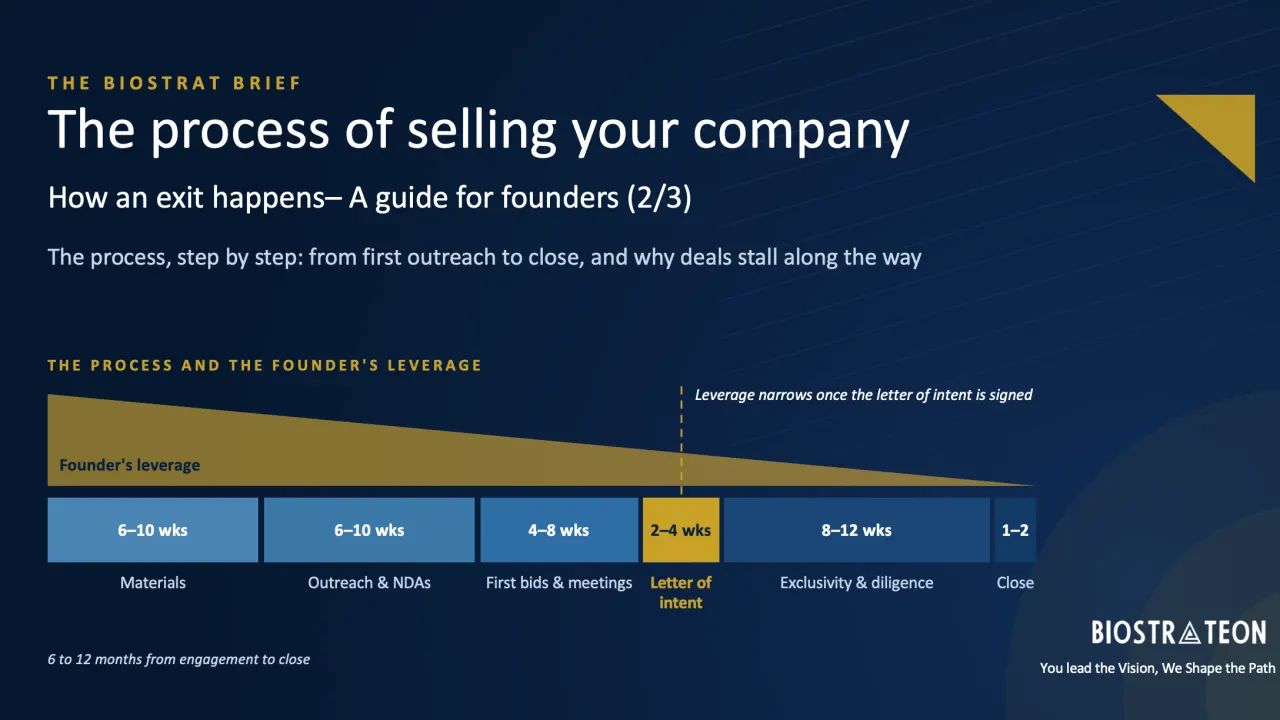
A full process typically takes six to twelve months from the day an advisor is engaged to the day the deal closes.
Timeline of a company sale process, from advisor engagement to close

Step 1: Build a funnel as large as possible

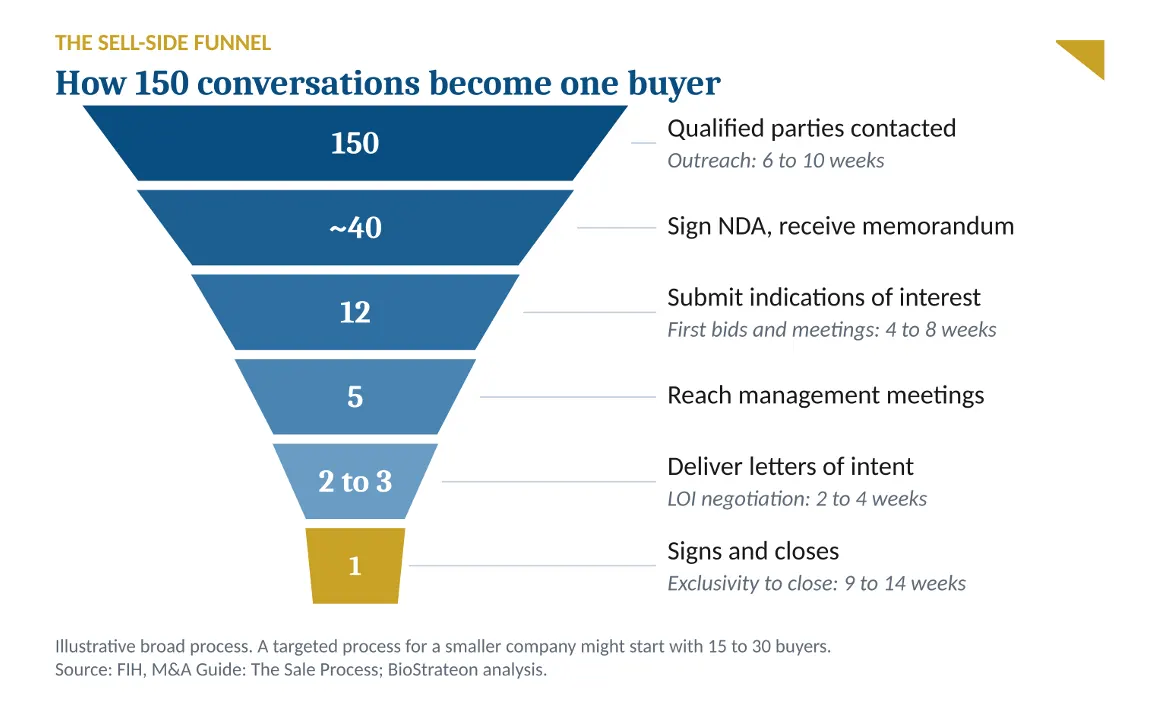
A company sale process, just like the sales for your offerings, should begin with a large funnel. A typical process starts with 100-150 qualified parties (smaller if you are a niche area). For a smaller company the numbers scale down, and a targeted process of 15 to 30 well-chosen buyers is more realistic.

That list is defined by buyer persona's identified in the prepartion (article part 1). The founder I described in Part 1 was running his conversations one at a time, which gave each buyer as much time as it wanted. When several buyers move in parallel towards a common deadline, they price against each other and the time.

Step 2: Release information in stages

Information moves through the funnel in steps.

  • The anonymous teaser goes out first - details of offerings, broadly a business outline (revenue, growth, PAT, size of team, location), some description of clients. Once an interest is received from prospective buyers, an NDA follows.

  • Post NDA, an Information memorandum (IM) follows - named disclosure, additional details about growth, clients, revenue, quality of revenue, market opportunity. Because this is hard to come by, I have created a hypothetical, lean version of a realistic business IM here.

Limited data follows a few questions, that can usually by answered by bankers. If the process has several buyers interested, this is usually followed by first bids.

The full data room opens only once a buyer has signed a letter of intent and entered exclusivity. Information is negotiating capital and each step of disclosure should secure a matching commitment from the buyer. The staging also protects confidentiality.

If you do no have an advisor, the founder/CEO must understand the kind of information that is needed be gated: customers, contracts or technology, as several strategic buyers are also competitors or could be evaluating another competitive deal.

Step 3: First bids and management meetings

First bids arrive as indications of interest: short, non-binding letters that give a valuation range and explain why the bidder is a good fit.

Four to six bidders typically go forward to management meetings, where the buyer's corporate development, strategy and operating teams meet the founder and leadership team. This is where the buyer tests the must-believes from part 1, and a founder who has prepared evidence for each one can move the internal case forward in a single meeting. Many acquirers, PE-backed ones in particular, also run technical and commercial diligence before they commit to a price.

When the funnel is small and you only have 2-3 potential serious buyers, the management meetings often begin before the LOI to ensure dialogs progress

This is where many deals break, but we will go into that at last in this article

Step 4: The letter of intent

The letter of intent sets out price, structure and process - It covers enterprise value on a cash-free, debt-free basis, the split between cash at close and deferred payments, and terms such as exclusivity and the timeline to a signed agreement.

Price and structure are generally non-binding, while exclusivity and confidentiality almost always bind. In practice, the non-binding price becomes the anchor for everything that follows, and what that price is actually made of is the subject of Part 3.

Signing it changes the founder's position. Before it, several buyers discipline every term; after it, you have a ticking clock with a single counterparty. Exclusivity of 60 to 90 days is standard.

  • Settle the material terms in the letter itself- treatment of working capital, founder's own role, retention structures for key employees- because they can deal breakers later and waste everyone's time during diligence.

  • A predefined diligence checklist (flexible to some extent) and a short exclusivity period to finish the diligence - Many buyers, when not operating in good faith, can keep dragging the period and you can loose any potential chance to reinitiating with other parties.

  • If there are deferred or milestone payments tied to business performance, define access to resources, ownership of goals and budgets clearly - more often than not, sellers agree to achieve revenue milestones only to realize the bottle neck in new organization was out of their control.

Step 5: From exclusivity to close

Confirmatory diligence and the purchase agreement follows. 3 common reasons valuations change in this period: quality of earnings findings, such as aggressive revenue recognition or unsupported adjustments; the working capital target, which is defined precisely only in the purchase agreement; and late discoveries in tax, contracts, litigation or compliance.

Life sciences and health technology companies face a recurring set of diligence issues:

  • Unclear ownership of intellectual property

  • Buyers want product-specific data under the company's control but research materials received under a transfer agreement are usually licensed for research use only

  • Customer contracts: pharma and CRO agreements often let the customer terminate if the company changes hands

  • Regulatory authorisations

Why deals stall, and what the hiccups usually mean

Few processes run in a straight line, and most founders I speak with describe the stalls as the hardest part.

Axial reviewed 75 lower mid-market deals whose signed letters of intent broke in 2025. Non-financial diligence findings caused 25.3% of the failures, quality of earnings discrepancies 21.3% (double their 2023 share), renegotiation 14.7%, sellers walking away 13.3% and financing 10.7%. Healthcare deals spent an average of 110 days in exclusivity before they broke.
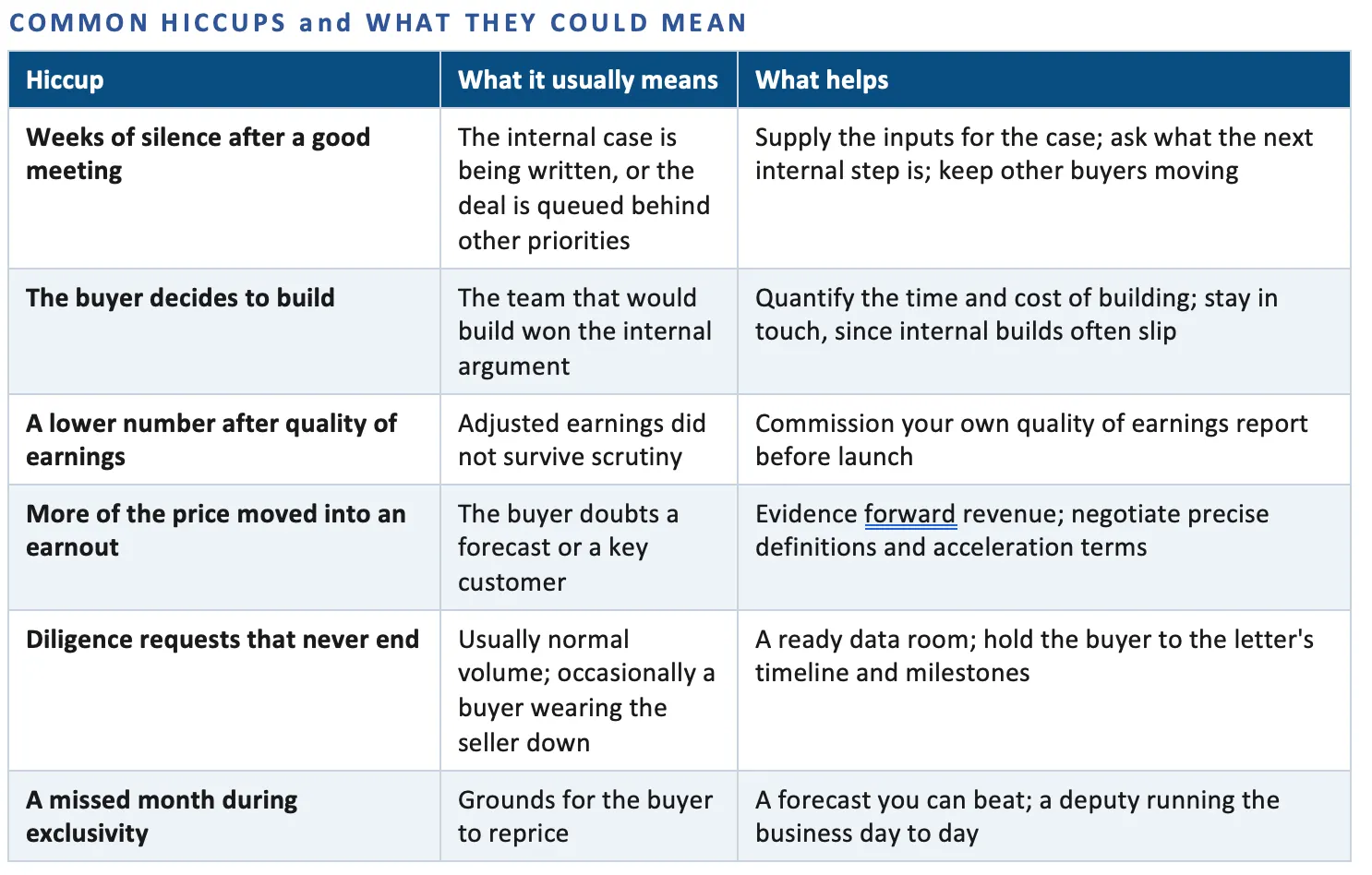
Why signed letters of intent broke in 2025, by cause

In cases I shared in Engineered for Exit, a founder's personal expenses in the accounts led the buyer to question every number, and a sales team let slip over a diligence dinner that it planned to leave after the deal, undermining the buyer's whole thesis.

The anxiety comes mostly from what the founder cannot see. The time from deciding to explore a sale to having proceeds in the bank could be anywhere from 12 to 18 months, with several hundred diligence requests along the way, while the founder runs the company under monthly scrutiny and keeps the process from most of the team.

Exhausted founders tend to accept weaker terms simply to make the process end. A fixed weekly rhythm for deal work, a second-in-command who runs the business day to day, and an adviser who absorbs the back and forth all help keep judgement intact.

Coming in Part 3

In Part 3, I will cover how buyers value a company, which multiple a founder is likely to be priced on and what moves it, and how much of $40 million headline number reaches a founder's account.

About the author

Amandeep Singh, PhD, is the Founder of BioStrateon, a life sciences and healthcare focused advisory firm. He advises founders and investors on exits, fundraising, growth strategy, business-model design and M&A across drug discovery, diagnostics, clinical research technology and digital health. Reach him at info@biostrateon.com.

First published in The BioStrat Brief on LinkedIn, 3 November 2026. Subscribe to The BioStrat Brief for a dealmaker's take on M&A, fundraising, strategy and markets in life sciences.

Amandeep Singh, Ph.D.

Amandeep Singh, Ph.D.

Founder, BioStrateon

Amandeep is the Founder of BioStrateon, a boutique corporate strategy and growth advisory firm for the life sciences sector. He leverages deep domain expertise in drug discovery and dealmaking to help companies navigate capital markets, prioritise pipelines, and partner with big pharma.

View LinkedIn profile
Back to Insights

The BioStrat Brief

A dealmaker's take on M&A, fundraising, strategy and markets in life sciences and healthcare

The BioStrat Brief draws on perspectives and observations gathered through our work. Each new edition is published on LinkedIn.

Read the Brief on LinkedIn

Biostrat Brief

The process of selling your business – A guide for founders (2/3)

  • Amandeep Singh, Ph.D.
  • 3 November 2026
  • 6 min read
M&A

In Part 1, we looked at the preparation: what the company needs from a transaction, who values it most, and how a strategic buyer builds its case to acquire.

This part walks through the process itself, what happens step by step if you work with an advisor or banker. If you are approached by a strategic acquirer and you have only 1 conversation ongoing, it is almost certain have left value on the table. Part 1 shared how the founder's leverage is greatest at the top of the funnel and narrows at every stage after it.

Part 3 will cover the two most important questions founders usually ask first: what the company is worth, and what they actually walk away with.

A full process typically takes six to twelve months from the day an advisor is engaged to the day the deal closes.

Timeline of a company sale process, from advisor engagement to close

Step 1: Build a funnel as large as possible

A company sale process, just like the sales for your offerings, should begin with a large funnel. A typical process starts with 100-150 qualified parties (smaller if you are a niche area). For a smaller company the numbers scale down, and a targeted process of 15 to 30 well-chosen buyers is more realistic.

That list is defined by buyer persona's identified in the prepartion (article part 1). The founder I described in Part 1 was running his conversations one at a time, which gave each buyer as much time as it wanted. When several buyers move in parallel towards a common deadline, they price against each other and the time.

Step 2: Release information in stages

Information moves through the funnel in steps.

  • The anonymous teaser goes out first - details of offerings, broadly a business outline (revenue, growth, PAT, size of team, location), some description of clients. Once an interest is received from prospective buyers, an NDA follows.

  • Post NDA, an Information memorandum (IM) follows - named disclosure, additional details about growth, clients, revenue, quality of revenue, market opportunity. Because this is hard to come by, I have created a hypothetical, lean version of a realistic business IM here.

Limited data follows a few questions, that can usually by answered by bankers. If the process has several buyers interested, this is usually followed by first bids.

The full data room opens only once a buyer has signed a letter of intent and entered exclusivity. Information is negotiating capital and each step of disclosure should secure a matching commitment from the buyer. The staging also protects confidentiality.

If you do no have an advisor, the founder/CEO must understand the kind of information that is needed be gated: customers, contracts or technology, as several strategic buyers are also competitors or could be evaluating another competitive deal.

Step 3: First bids and management meetings

First bids arrive as indications of interest: short, non-binding letters that give a valuation range and explain why the bidder is a good fit.

Four to six bidders typically go forward to management meetings, where the buyer's corporate development, strategy and operating teams meet the founder and leadership team. This is where the buyer tests the must-believes from part 1, and a founder who has prepared evidence for each one can move the internal case forward in a single meeting. Many acquirers, PE-backed ones in particular, also run technical and commercial diligence before they commit to a price.

When the funnel is small and you only have 2-3 potential serious buyers, the management meetings often begin before the LOI to ensure dialogs progress

This is where many deals break, but we will go into that at last in this article

Step 4: The letter of intent

The letter of intent sets out price, structure and process - It covers enterprise value on a cash-free, debt-free basis, the split between cash at close and deferred payments, and terms such as exclusivity and the timeline to a signed agreement.

Price and structure are generally non-binding, while exclusivity and confidentiality almost always bind. In practice, the non-binding price becomes the anchor for everything that follows, and what that price is actually made of is the subject of Part 3.

Signing it changes the founder's position. Before it, several buyers discipline every term; after it, you have a ticking clock with a single counterparty. Exclusivity of 60 to 90 days is standard.

  • Settle the material terms in the letter itself- treatment of working capital, founder's own role, retention structures for key employees- because they can deal breakers later and waste everyone's time during diligence.

  • A predefined diligence checklist (flexible to some extent) and a short exclusivity period to finish the diligence - Many buyers, when not operating in good faith, can keep dragging the period and you can loose any potential chance to reinitiating with other parties.

  • If there are deferred or milestone payments tied to business performance, define access to resources, ownership of goals and budgets clearly - more often than not, sellers agree to achieve revenue milestones only to realize the bottle neck in new organization was out of their control.

Step 5: From exclusivity to close

Confirmatory diligence and the purchase agreement follows. 3 common reasons valuations change in this period: quality of earnings findings, such as aggressive revenue recognition or unsupported adjustments; the working capital target, which is defined precisely only in the purchase agreement; and late discoveries in tax, contracts, litigation or compliance.

Life sciences and health technology companies face a recurring set of diligence issues:

  • Unclear ownership of intellectual property

  • Buyers want product-specific data under the company's control but research materials received under a transfer agreement are usually licensed for research use only

  • Customer contracts: pharma and CRO agreements often let the customer terminate if the company changes hands

  • Regulatory authorisations

Why deals stall, and what the hiccups usually mean

Few processes run in a straight line, and most founders I speak with describe the stalls as the hardest part.

Axial reviewed 75 lower mid-market deals whose signed letters of intent broke in 2025. Non-financial diligence findings caused 25.3% of the failures, quality of earnings discrepancies 21.3% (double their 2023 share), renegotiation 14.7%, sellers walking away 13.3% and financing 10.7%. Healthcare deals spent an average of 110 days in exclusivity before they broke.

Why signed letters of intent broke in 2025, by cause

In cases I shared in Engineered for Exit, a founder's personal expenses in the accounts led the buyer to question every number, and a sales team let slip over a diligence dinner that it planned to leave after the deal, undermining the buyer's whole thesis.

The anxiety comes mostly from what the founder cannot see. The time from deciding to explore a sale to having proceeds in the bank could be anywhere from 12 to 18 months, with several hundred diligence requests along the way, while the founder runs the company under monthly scrutiny and keeps the process from most of the team.

Exhausted founders tend to accept weaker terms simply to make the process end. A fixed weekly rhythm for deal work, a second-in-command who runs the business day to day, and an adviser who absorbs the back and forth all help keep judgement intact.

Coming in Part 3

In Part 3, I will cover how buyers value a company, which multiple a founder is likely to be priced on and what moves it, and how much of $40 million headline number reaches a founder's account.

About the author

Amandeep Singh, PhD, is the Founder of BioStrateon, a life sciences and healthcare focused advisory firm. He advises founders and investors on exits, fundraising, growth strategy, business-model design and M&A across drug discovery, diagnostics, clinical research technology and digital health. Reach him at info@biostrateon.com.

First published in The BioStrat Brief on LinkedIn, 3 November 2026. Subscribe to The BioStrat Brief for a dealmaker's take on M&A, fundraising, strategy and markets in life sciences.
Amandeep Singh, Ph.D.

Amandeep Singh, Ph.D.

Founder, BioStrateon

Amandeep is the Founder of BioStrateon, a boutique corporate strategy and growth advisory firm for the life sciences sector. He leverages deep domain expertise in drug discovery and dealmaking to help companies navigate capital markets, prioritise pipelines, and partner with big pharma.

View LinkedIn profile
Back to Insights

The BioStrat Brief

A dealmaker's take on M&A, fundraising, strategy and markets in life sciences and healthcare

The BioStrat Brief draws on perspectives and observations gathered through our work. Each new edition is published on LinkedIn.

Read the Brief on LinkedIn

Biostrat Brief

The process of selling your business – A guide for founders (2/3)

  • Amandeep Singh, Ph.D.
  • 3 November 2026
  • 6 min read
M&A

In Part 1, we looked at the preparation: what the company needs from a transaction, who values it most, and how a strategic buyer builds its case to acquire.

This part walks through the process itself, what happens step by step if you work with an advisor or banker. If you are approached by a strategic acquirer and you have only 1 conversation ongoing, it is almost certain have left value on the table. Part 1 shared how the founder's leverage is greatest at the top of the funnel and narrows at every stage after it.

Part 3 will cover the two most important questions founders usually ask first: what the company is worth, and what they actually walk away with.

A full process typically takes six to twelve months from the day an advisor is engaged to the day the deal closes.

Timeline of a company sale process, from advisor engagement to close

Step 1: Build a funnel as large as possible

A company sale process, just like the sales for your offerings, should begin with a large funnel. A typical process starts with 100-150 qualified parties (smaller if you are a niche area). For a smaller company the numbers scale down, and a targeted process of 15 to 30 well-chosen buyers is more realistic.

That list is defined by buyer persona's identified in the prepartion (article part 1). The founder I described in Part 1 was running his conversations one at a time, which gave each buyer as much time as it wanted. When several buyers move in parallel towards a common deadline, they price against each other and the time.

Step 2: Release information in stages

Information moves through the funnel in steps.

  • The anonymous teaser goes out first - details of offerings, broadly a business outline (revenue, growth, PAT, size of team, location), some description of clients. Once an interest is received from prospective buyers, an NDA follows.

  • Post NDA, an Information memorandum (IM) follows - named disclosure, additional details about growth, clients, revenue, quality of revenue, market opportunity. Because this is hard to come by, I have created a hypothetical, lean version of a realistic business IM here.

Limited data follows a few questions, that can usually by answered by bankers. If the process has several buyers interested, this is usually followed by first bids.

The full data room opens only once a buyer has signed a letter of intent and entered exclusivity. Information is negotiating capital and each step of disclosure should secure a matching commitment from the buyer. The staging also protects confidentiality.

If you do no have an advisor, the founder/CEO must understand the kind of information that is needed be gated: customers, contracts or technology, as several strategic buyers are also competitors or could be evaluating another competitive deal.

Step 3: First bids and management meetings

First bids arrive as indications of interest: short, non-binding letters that give a valuation range and explain why the bidder is a good fit.

Four to six bidders typically go forward to management meetings, where the buyer's corporate development, strategy and operating teams meet the founder and leadership team. This is where the buyer tests the must-believes from part 1, and a founder who has prepared evidence for each one can move the internal case forward in a single meeting. Many acquirers, PE-backed ones in particular, also run technical and commercial diligence before they commit to a price.

When the funnel is small and you only have 2-3 potential serious buyers, the management meetings often begin before the LOI to ensure dialogs progress

This is where many deals break, but we will go into that at last in this article

Step 4: The letter of intent

The letter of intent sets out price, structure and process - It covers enterprise value on a cash-free, debt-free basis, the split between cash at close and deferred payments, and terms such as exclusivity and the timeline to a signed agreement.

Price and structure are generally non-binding, while exclusivity and confidentiality almost always bind. In practice, the non-binding price becomes the anchor for everything that follows, and what that price is actually made of is the subject of Part 3.

Signing it changes the founder's position. Before it, several buyers discipline every term; after it, you have a ticking clock with a single counterparty. Exclusivity of 60 to 90 days is standard.

  • Settle the material terms in the letter itself- treatment of working capital, founder's own role, retention structures for key employees- because they can deal breakers later and waste everyone's time during diligence.

  • A predefined diligence checklist (flexible to some extent) and a short exclusivity period to finish the diligence - Many buyers, when not operating in good faith, can keep dragging the period and you can loose any potential chance to reinitiating with other parties.

  • If there are deferred or milestone payments tied to business performance, define access to resources, ownership of goals and budgets clearly - more often than not, sellers agree to achieve revenue milestones only to realize the bottle neck in new organization was out of their control.

Step 5: From exclusivity to close

Confirmatory diligence and the purchase agreement follows. 3 common reasons valuations change in this period: quality of earnings findings, such as aggressive revenue recognition or unsupported adjustments; the working capital target, which is defined precisely only in the purchase agreement; and late discoveries in tax, contracts, litigation or compliance.

Life sciences and health technology companies face a recurring set of diligence issues:

  • Unclear ownership of intellectual property

  • Buyers want product-specific data under the company's control but research materials received under a transfer agreement are usually licensed for research use only

  • Customer contracts: pharma and CRO agreements often let the customer terminate if the company changes hands

  • Regulatory authorisations

Why deals stall, and what the hiccups usually mean

Few processes run in a straight line, and most founders I speak with describe the stalls as the hardest part.

Axial reviewed 75 lower mid-market deals whose signed letters of intent broke in 2025. Non-financial diligence findings caused 25.3% of the failures, quality of earnings discrepancies 21.3% (double their 2023 share), renegotiation 14.7%, sellers walking away 13.3% and financing 10.7%. Healthcare deals spent an average of 110 days in exclusivity before they broke.

Why signed letters of intent broke in 2025, by cause

In cases I shared in Engineered for Exit, a founder's personal expenses in the accounts led the buyer to question every number, and a sales team let slip over a diligence dinner that it planned to leave after the deal, undermining the buyer's whole thesis.

The anxiety comes mostly from what the founder cannot see. The time from deciding to explore a sale to having proceeds in the bank could be anywhere from 12 to 18 months, with several hundred diligence requests along the way, while the founder runs the company under monthly scrutiny and keeps the process from most of the team.

Exhausted founders tend to accept weaker terms simply to make the process end. A fixed weekly rhythm for deal work, a second-in-command who runs the business day to day, and an adviser who absorbs the back and forth all help keep judgement intact.

Coming in Part 3

In Part 3, I will cover how buyers value a company, which multiple a founder is likely to be priced on and what moves it, and how much of $40 million headline number reaches a founder's account.

About the author

Amandeep Singh, PhD, is the Founder of BioStrateon, a life sciences and healthcare focused advisory firm. He advises founders and investors on exits, fundraising, growth strategy, business-model design and M&A across drug discovery, diagnostics, clinical research technology and digital health. Reach him at info@biostrateon.com.

First published in The BioStrat Brief on LinkedIn, 3 November 2026. Subscribe to The BioStrat Brief for a dealmaker's take on M&A, fundraising, strategy and markets in life sciences.
Amandeep Singh, Ph.D.

Amandeep Singh, Ph.D.

Founder, BioStrateon

Amandeep is the Founder of BioStrateon, a boutique corporate strategy and growth advisory firm for the life sciences sector. He leverages deep domain expertise in drug discovery and dealmaking to help companies navigate capital markets, prioritise pipelines, and partner with big pharma.

View LinkedIn profile
Back to Insights

The BioStrat Brief

A dealmaker's take on M&A, fundraising, strategy and markets in life sciences and healthcare

The BioStrat Brief draws on perspectives and observations gathered through our work. Each new edition is published on LinkedIn.

Read the Brief on LinkedIn