The BioStrat Brief · Amandeep Singh, Ph.D. ·
Life Sciences @ Anthropic, OpenAI, Google, NVIDIA & others AI labs
Part 1 of our frontier AI x bio series: what the labs actually shipped in biology, what has been validated, and why the moat has moved from the model to the loop.
The frontier labs have moved faster in biology than the evidence base has moved to check them. Here is what actually shipped, what has been validated, and why the moat has quietly stopped being the model.
We are writing a series of articles on what is happening in life sciences models in frontier AI companies, covering what it means for the industry, how investors should think, and what founders can do in this rapidly changing environment. This is part 1. Parts two, three and four take the founder, investor and M&A views in turn.
On 1 September, Anthropic shipped the same model twice. Claude Fable 5.1 went to everyone and redirects certain biology and chemistry questions to an older model. Claude Mythos 5.1 (the full-capability version) went behind a Life Sciences Verification Program run in partnership with the US government, and is currently available only to a set of US organisations. Two days later, OpenAI shipped GPT-6 Astra to every paid tier, biology included.
In eleven days, the sector learned two things it had not fully absorbed. Capability in biology is now improving faster than anyone can independently verify it. And access to that capability has become a regulatory question rather than a pricing one, which means, for the first time, where your company is incorporated may determine what science it can do.
What actually shipped
Strip out the announcements and the twelve-month record is substantial:
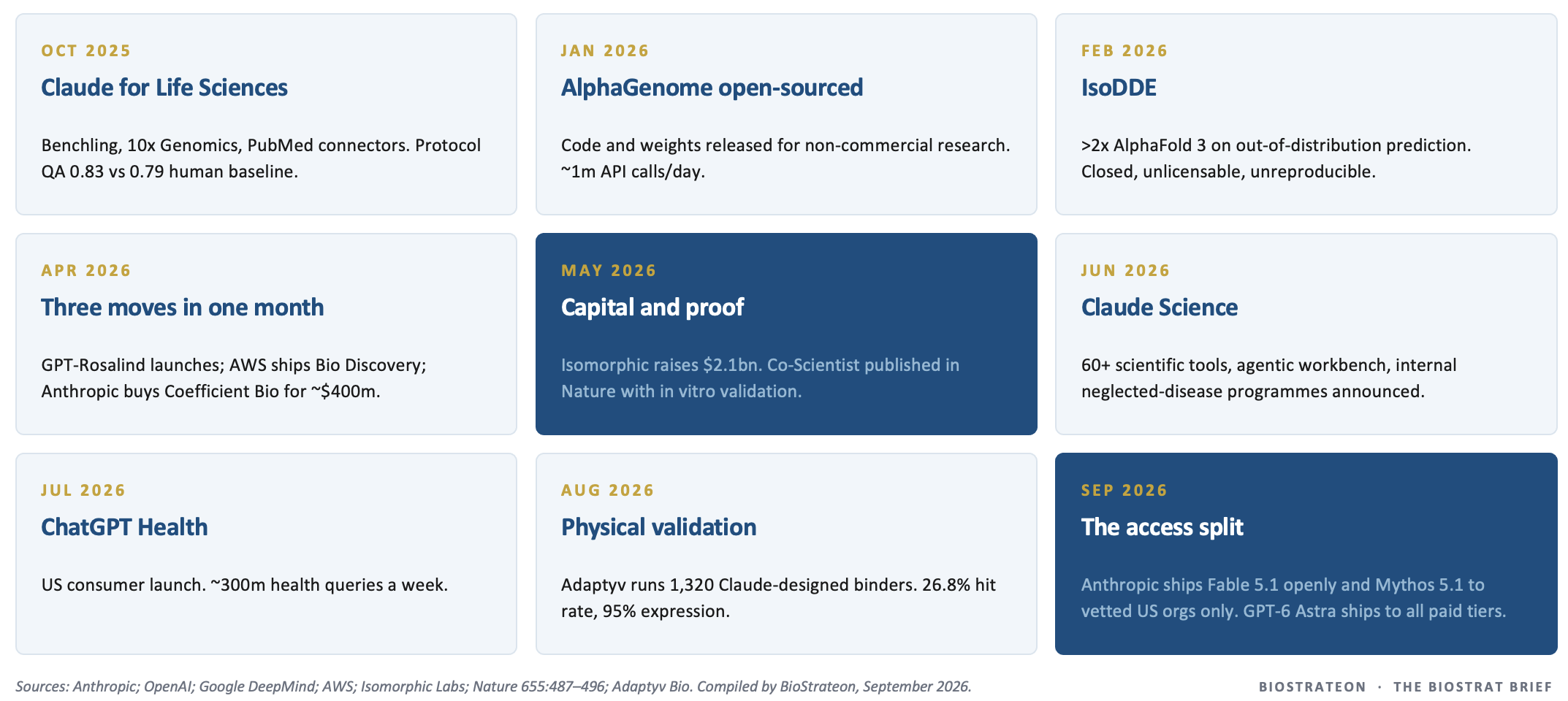
Anthropic: Claude for Life Sciences with Benchling, 10x Genomics and PubMed connectors; the ~$400m acquisition of Coefficient Bio — fewer than ten people; Novartis CEO Vas Narasimhan joining the board; a 30,000-seat deployment at Bristol Myers Squibb; and Claude Science, a 60-tool scientific workbench, in June.
OpenAI: GPT-Rosalind, the first domain-specific life sciences model from a frontier lab (April); an enterprise-wide Novo Nordisk partnership; and ChatGPT Health, which in September added a read-only Epic integration reaching an installed base of 325 million patients.
Alphabet: Isomorphic Labs raised $2.1bn in May; AlphaGenome was open-sourced in January; Merck signed a deal worth up to $1bn for Gemini Enterprise across 75,000 employees; and Google Health launched a consumer coach at $9.99/month.
NVIDIA and AWS: a $1bn NVIDIA–Lilly co-innovation lab linking wet labs to compute; Amazon Bio Discovery, which ships biological foundation models bundled with synthesis and testing partners and a free trial.
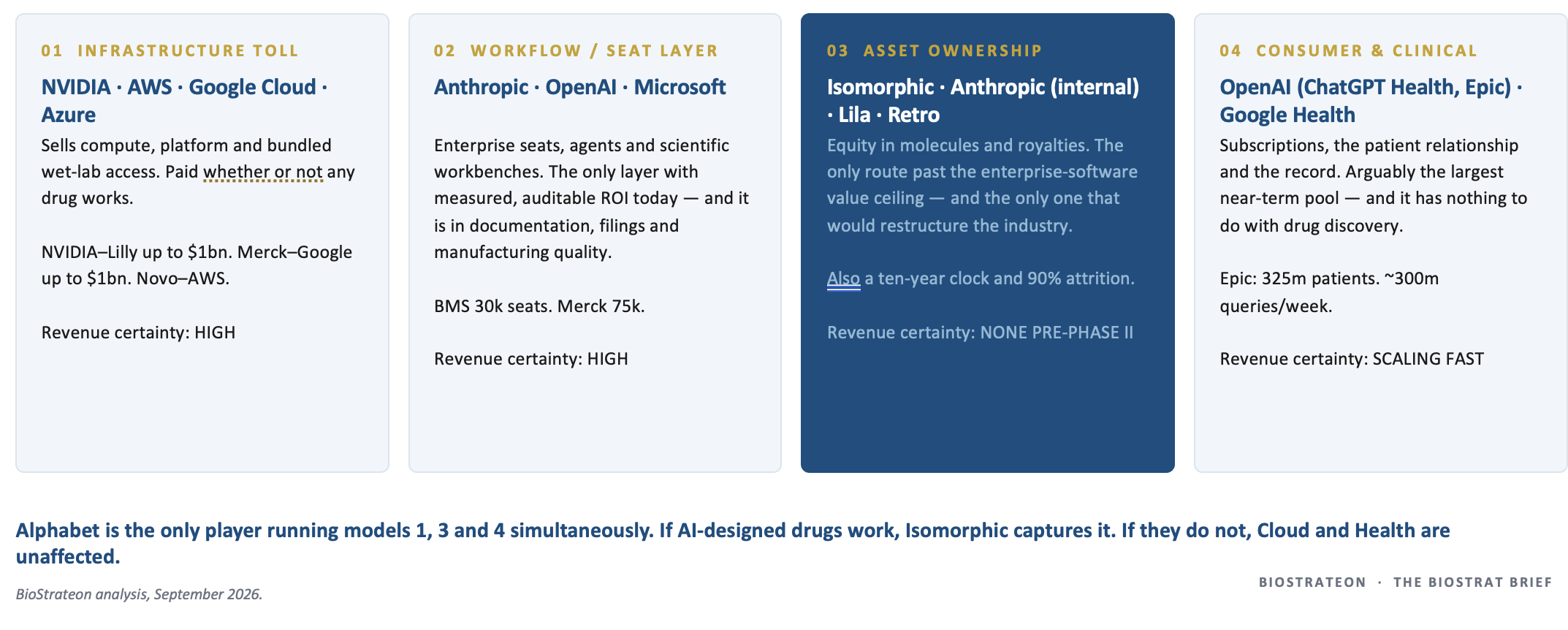
The pattern is not subtle. Nobody is selling a model. Everybody is selling a loop.
The two camps are not doing the same thing, and the difference is financial rather than scientific.
Big Tech is selling capacity into an industry that is frightened of being late - NVIDIA gives BioNeMo away because it sells the substrate; AWS bundles synthesis partners because it sells the loop; Google embeds engineers at Merck because it sells consumption. None of those deals requires a drug to work to be profitable.
The frontier labs have no such base. Enterprise seat revenue has a headcount ceiling, and it is a ceiling neither OpenAI's nor Anthropic's valuation clears comfortably. Drug economics have no ceiling. That single asymmetry explains why Anthropic bought a ten-person biology team, started internal neglected-disease programmes, and put a sitting pharma CEO on its board, while NVIDIA was content to sign a partnership and sell GPUs.
Between all the claims, what is genuinely validated
There is real evidence here, and dismissing it as hype is no longer a serious position.
Co-Scientist was published in Nature in May with in vitro confirmation across three domains: in AML repurposing, binimetinib showed IC50 values as low as 2nM and KIRA6 an 18-fold selectivity window; in liver fibrosis, two proposed agents showed anti-fibrotic activity in hepatic organoids without cytotoxicity; in antimicrobial resistance, the system independently proposed a mechanism that matched unpublished, co-timed experimental findings.
On the design side, Chai-2 reported 16–20% zero-shot de novo antibody hit rates against a field norm of 10–15%. And in August, Adaptyv Bio ran 1,320 Claude-designed binders through its automated wet lab across 15 analysable targets — 26.8% overall hit rate, 95% expression, binding measured by surface plasmon resonance at five concentrations in duplicate. Eleven days later Anthropic claimed nearly 50% across a different 12-target set.
Physical measurement at that scale is the strongest evidence any frontier lab has produced. It is also worth naming what it is not: Adaptyv ran the wet lab as a paid service provider. That is third-party execution, not third-party adjudication.
What has not moved at all
Roughly 90% of candidates entering clinical development still fail. Approval probability remains inside the historic 8–12% band. A 2026 review in Pharmaceuticals puts more than $100bn into AI-enabled discovery between 2022 and 2026 against no measurable improvement in late-stage attrition- alongside a reproducibility problem in which roughly 6% of AI research studies publish source code.
The bottleneck has migrated from "can we make a molecule" to "can we predict human biology," and the second is a data problem that compute does not solve, because the data is generated by trials that take years.
There is a second, quieter problem. In February, Isomorphic published IsoDDE, reporting more than double AlphaFold 3's accuracy on out-of-distribution protein–ligand prediction and superior binding-affinity estimates to physics-based free-energy methods at a fraction of the cost.
It is not released, not licensable, and not reproducible by anyone outside the company.
Nature called it "an AlphaFold 4" and framed the story around exactly that: a genuine advance that leaves open-source developers guessing how to get there. Isomorphic's own clinical guidance meanwhile slipped from end-2025 to end-2026, and as of early September there is no public confirmation that a first patient has been dosed.
The benchmark problem, in one number
Anthropic reports 52.6% on Terminal-Bench-Science. OpenAI reports 64.6%. The benchmark itself is independent, built by Stanford and the Laude Institute, 70 tasks, 19 of them life sciences, deterministic scoring, and its public leaderboard tops out at 30.0% (±3.2) for Claude Opus 5, with GPT-5.6 Sol at 22.4% and Claude Fable 5 at 21.4%.
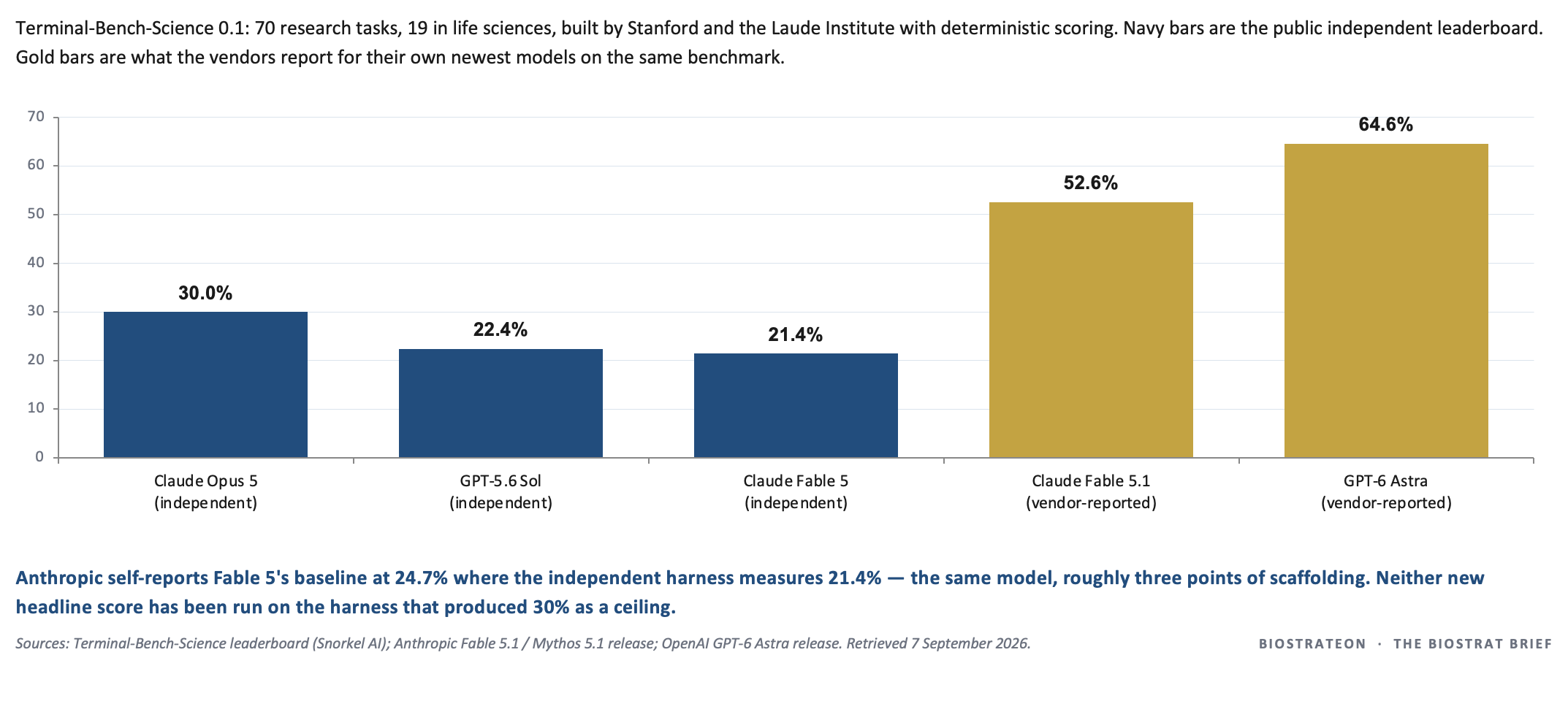
Note that last figure. Anthropic self-reports Fable 5's baseline at 24.7% where the independent harness measures 21.4%. Same model, roughly three points of scaffolding. Neither of the new headline scores has been run on the harness that produced 30% as a ceiling.
For buyers, the practical consequence is simple. A vendor benchmark is capability advertising. The question that actually discriminates in procurement is: run this blind against three years of our own retrospective programme data and show us where you were wrong. Vendors who offer that unprompted are worth more than vendors who lead with a leaderboard.
What it changes: moats, capital, consolidation
Moats. Model capability is being commoditised deliberately, from above, by parties who make their money elsewhere. AlphaGenome was open-sourced. BioNeMo is given away with an agent toolkit and roughly 50 partners. Amazon bundles biological foundation models into a product with a free trial. What is not being commoditised is the closed loop between model and experiment, which is precisely why Lilly built TuneLab on more than $1bn of proprietary data, why AWS put Twist and Ginkgo inside its product, and why Anthropic had to go to Adaptyv to find out whether its proteins bound to anything. The moat has shifted from the model to the loop. Part 2 works through what that means if you are building one.
Capital. The money has followed the same logic. Of the $21.5bn raised across 161 biotech financings through 6 September 2026, a single round- Isomorphic's $2.1bn — is close to a tenth. Part 3 goes through the last six months properly.
Consolidation. And here is the fact that should reorder your priors. The most expensive acquisition in this entire space over the past two years was not a pipeline and not a model. It was Dotmatics, R&D software, bought by Siemens for $5.1bn — roughly 7.4 times the price of Recursion/Exscientia, the largest AI-platform consolidation. Part 4 takes that apart.
It's still Comsi-comsa
Novo Nordisk's Lotte Bjerre Knudsen said it best at the Claude Science launch: "We're going to have to listen to Derek Lowe, probably for another 10 years." Anthropic's own CEO, asked whether AI becomes a general-purpose scientific collaborator, answered: "We don't know for sure."
Two things are true simultaneously, and both should be held. The technical progress at the design step is real, replicated, and in places peer-reviewed. And nothing yet demonstrates that any of it changes the probability a molecule works in a human being, which is where roughly 90% of the cost and all of the risk sits. Anyone selling you certainty in either direction is selling something.
Next in the series: Part 2- what all of this means if you are building an AI × Bio company, and which four positions actually survive absorption.
About the author
Amandeep Singh, Ph.D., is the Founder of BioStrateon, a boutique corporate strategy and growth advisory firm for the life sciences sector. He advises tech-bio founders and investors on exits, fundraising, business-model design, and M&A across drug discovery and diagnostics. Reach him at info@biostrateon.com.
Sources
Nature — Accelerating scientific discovery with Co-Scientist, 655:487–496
Adaptyv Bio — Benchmarking Claude's protein designs in the wet lab
Terminal-Bench-Science leaderboard (Stanford / Laude Institute, via Snorkel AI)
Pharmaceuticals 19(6):916 — clinical failures and the validation crisis
Nature news — "An AlphaFold 4": scientists marvel at DeepMind spin-off's exclusive new AI
R&D World — Anthropic says AI can run science experiments now
BioStrateon is a life sciences strategic M&A advisory firm. This piece is analysis for discussion, not investment advice.
First published in The BioStrat Brief on LinkedIn, 8 September 2026. Subscribe to The BioStrat Brief for a dealmaker's take on M&A, fundraising, strategy and markets in life sciences.