The BioStrat Brief · Amandeep Singh, Ph.D. ·
Frontier AI Is Coming for Bio. Which Moats Survive?
Part 2 of our frontier AI x bio series: the five ways AI x bio moats fail as frontier labs absorb the stack, and the four positions that survive.
If you are in AI x Bio or Tech Bio company without a drug pipeline, and you have not asked this question yet: “Will we be crushed by the frontier labs”, then you must be living under a rock. Frontier AI is coming for life sciences, and the tide is coming in faster than most founders / VCs thought.
Part 1 of this series (published last month) covered what the frontier labs shipped in life sciences and funny enough it is already dated.
What history teaches us
Every big technology shift has the same second act. The platform absorbs the best ideas built on top of it.
Netscape learned this from Internet Explorer
A generation of iPhone torch apps learned it from iOS.
Twitter cut Meerkat's access to its social graph the same week it unveiled Periscope
Most recently, ChatGPT did it to Jasper
In 2002 a small Mac developer called Karelia learned it when Apple shipped Sherlock 3, which did much of what Karelia's Watson app did, for free, inside the operating system. Developers have called it being “Sherlocked” ever since.
2026 is the year AI tooling got Sherlocked. TechCrunch's running AI graveyard is dominated by a single failure mode – Killed by the Frontier tech co’s launching its applications.
Bio is next
I spent some time thinking about the AI x Bio space, and what the recent launches and moves could mean for the space. This piece is for the people building companies and VCs investing in it. It may be slightly longer, but I promise it will worth the read.
Unlike Tech, Bio is more complicated and it will take some time before the winners emerge – there is regulatory hurdles, deep trust issues in pharma, complicated ontologies that dictate the meaning of scientific relationships and of course, a very high error rate/duplication challenge for experiments.
But the pace at which frontier labs are progressing, makes me worry. Terminal-Bench-Science is an independent benchmark of real research workflows, built by Stanford and the Laude Institute with deterministic scoring. At the end of July the best independently measured score was 30%. Six weeks later it was 68%. In between, on 20 August, Adaptyv Bio published wet-lab results for 1,320 Claude-designed protein binders: a 26.8% hit rate. Twelve days later Anthropic claimed close to 50% on a different 12-target set.
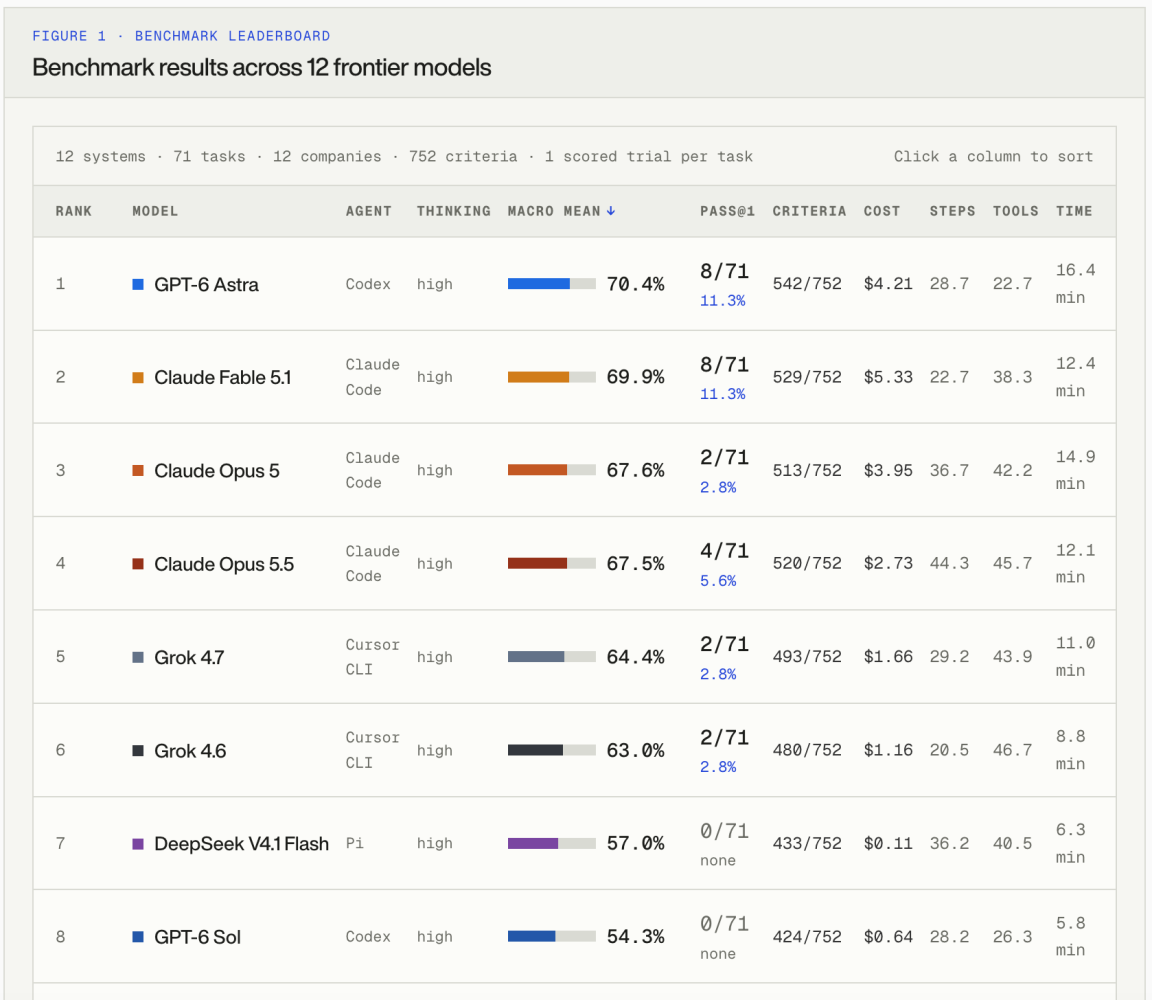
Image source: Raycaster.AI
There are 3 types of industry moves are forcing thinning of moat:
Frontier AI launching their own workbench: Claude science, GPT-Rosalind
Big tech collaborating with startups while winning on distribution: Amazon Bio Discovery, NVIDIA's BioNeMo agent toolkit
Domain incumbents launching their own tooling, directly or through acquisitions: Veeva (the system of record owner in >50% of pharma commercial teams) acquired copli, Certara has launched CoAuthor for regulatory and medical writing. So, for example, a medical writing startup is now squeezed by the incumbent from above and the general model from below, at the same time. That is a worse position than facing the frontier labs alone.
The moat could fail in one of five ways
Across every case I have looked at, the moat fails in one of five ways. They are listed roughly in order of how easily the moat dies:
Absorption of the wedge: The company that sells a single capability, say literature synthesis from diverse sources, becomes a default feature of another platform that biopharma already pays for. Claude Science shipped with PubMed and 60 other tools; GPT-Rosalind ships research plugins inside Codex.
Benchmark leapfrog: Your technical lead is erased by someone else's release note. The best independent research-workflow score went from 30% to 68% in six weeks. Isomorphic reports that IsoDDE is 19.8 times more accurate than Boltz-2 on high-fidelity antibody-antigen prediction. If that was your differentiation, it is just one release away from a big tech
Distribution foreclosure: Relied on a channel that was crucial to your operations. AWS launched their OMICS bench; Snowflake launched their own commercial agents. The scarce nature of large partners in this industry would lead to squeeze on independent tooling.
Capital structure mismatch: Trying to be a platform and an asset company at once and being capitalised properly for neither. Full of graveyard.
Billable-hour compression: AI x Bio company that sold services on the platform as billed against hours of cognitive work: Insilco design, bioinformatics workflows etc- now run on enterprise version of frontier models. Probably not the best quality today, but benchmarks are changing fast.
In addition, I would also add reduced cost to Inference (Anthropic cut cache read prices by 75%) and access- Anthropic's Life Sciences Verification, permissive Mythos grants etc could limit your ability - If you build in London or Basel, that is a question to settle before your next raise.
Here’s my shot at few categories
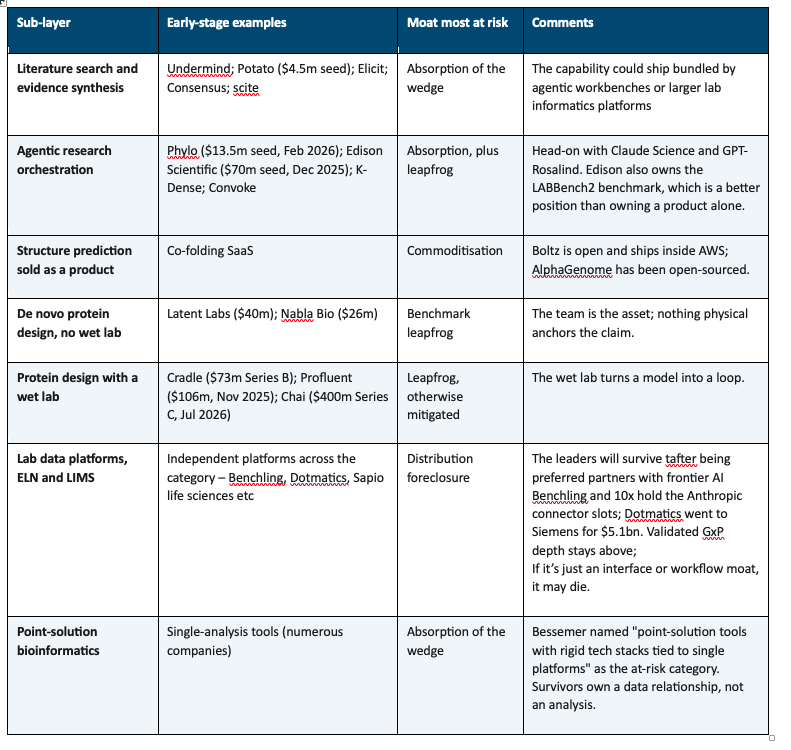
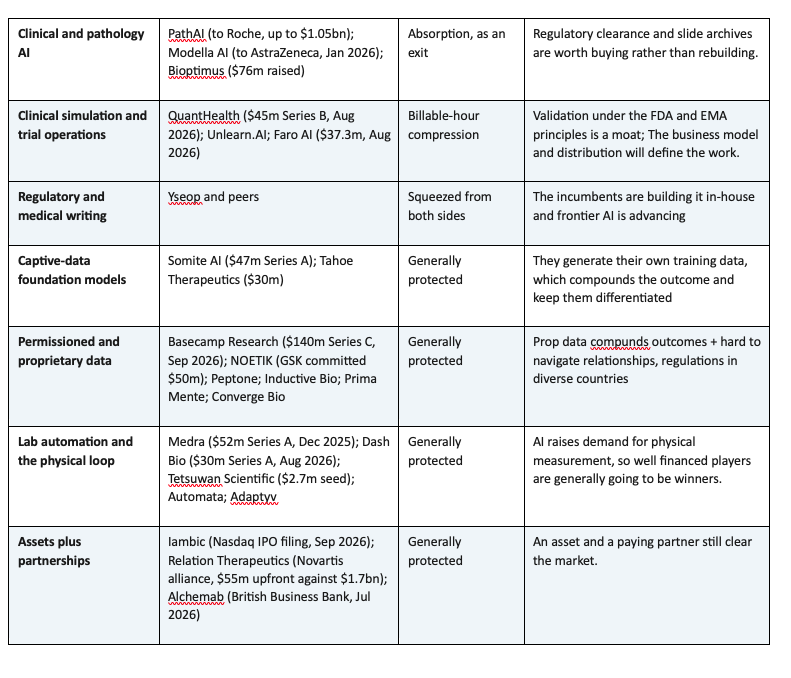
What survives:
1. Own the loop: Does each experiment you run makes the next one cheaper or better in a way a competitor cannot replicate by buying the same instruments -build it.
2. Own a regulated workflow. GxP, 21 CFR Part 11, validated systems, audit trails, inspection history. No frontier lab is going to sit through an inspection or carry the liability for a batch release decision.
3. Own permissioned data: Hospital agreements, consented cohorts, biobank access, benefit-sharing treaties – hard to build tight operations on it. OpenAI, Anthropic and Google have all reportedly been negotiating specialised data licences precisely because this cannot be scrapped.
4. Own the asset: self-explanatory
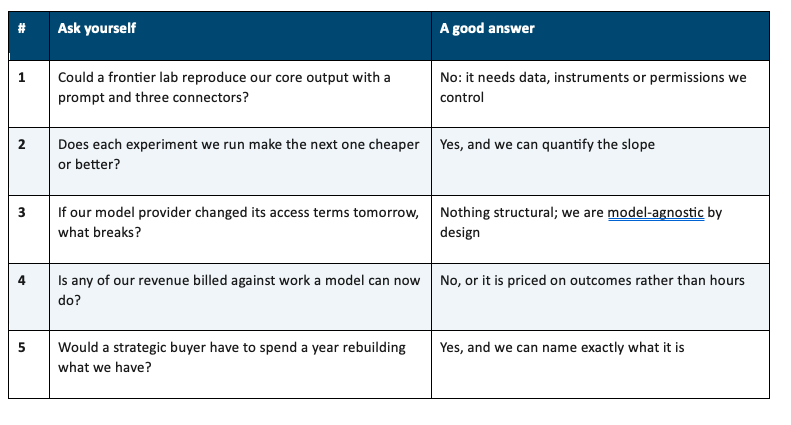
If you are a founder, ask yourself these questions:
OUR VIEW
The frontier labs are not going to leave the AI x Bio stack alone, and nobody should expect them to. After all, it’s a very big market. Every release will kill a few startups, but also make the ecosystem stronger.
Instruments, permissions, regulated status, proprietary biology and paying partners sit above the threat line, and I think smart capital has already realized it. If I had one test for an AI x Bio company in 2026, it would be this: what would a strategic buyer have to spend a year rebuilding? If the honest answer is nothing, then it’s a hard pass.
About the author: Amandeep Singh, Ph.D. is the Founder of BioStrateon, a boutique corporate strategy and growth advisory firm for the life sciences sector. He leverages his deep domain expertise in drug discovery and dealmaking to help companies navigate capital markets, prioritize pipelines, and partner with big pharma.
Further reading
Bessemer Venture Partners, Building biology-native data infrastructure for the AI era. April 2026.
Maggie Basta (Scale Venture Partners), The future of biological foundation models and value creation. May 2025.
Pablo Lubroth and Xinchen Wang (Scaling Biology), Defensibility Through Execution.
Jules Adam (Labiotech), What investors now expect from AI biotech companies.
Drug Target Review, The scale divide: competing strategies in AI drug discovery. March 2026.
Nature Biotechnology, Frontier AI companies as biotech acquirers. July 2026.
First published in The BioStrat Brief on LinkedIn, 6 October 2026. Subscribe to The BioStrat Brief for a dealmaker's take on M&A, fundraising, strategy and markets in life sciences.