Lab automation software is being rebuilt around AI agents. This Outlook sets out how an AI native Design-Make-Test-Analyze workflow reshapes the market, and where life sciences software companies should reposition.
A market gathering pace
R&D lab software (excluding clinical trials) was a $5.5B market in 2025, growing at around 14% a year through 2032.
Pharma companies expect to put around 4.5% of revenue into digital transformation, and more than three quarters have already begun modernising their labs.
Over 60% of biopharma executives plan to increase investment in digital transformation and generative AI.
What holds labs back
Data silos, low interoperability and fragmented tools remain the main barriers. Electronic lab notebooks, LIMS, quality systems, data management and analytics applications have grown up separately. CIOs want analytics that work on top of the infrastructure they have already paid for, not another re-platforming, and the harder problem is the variety and complexity of lab data rather than its volume.
The lab of the future
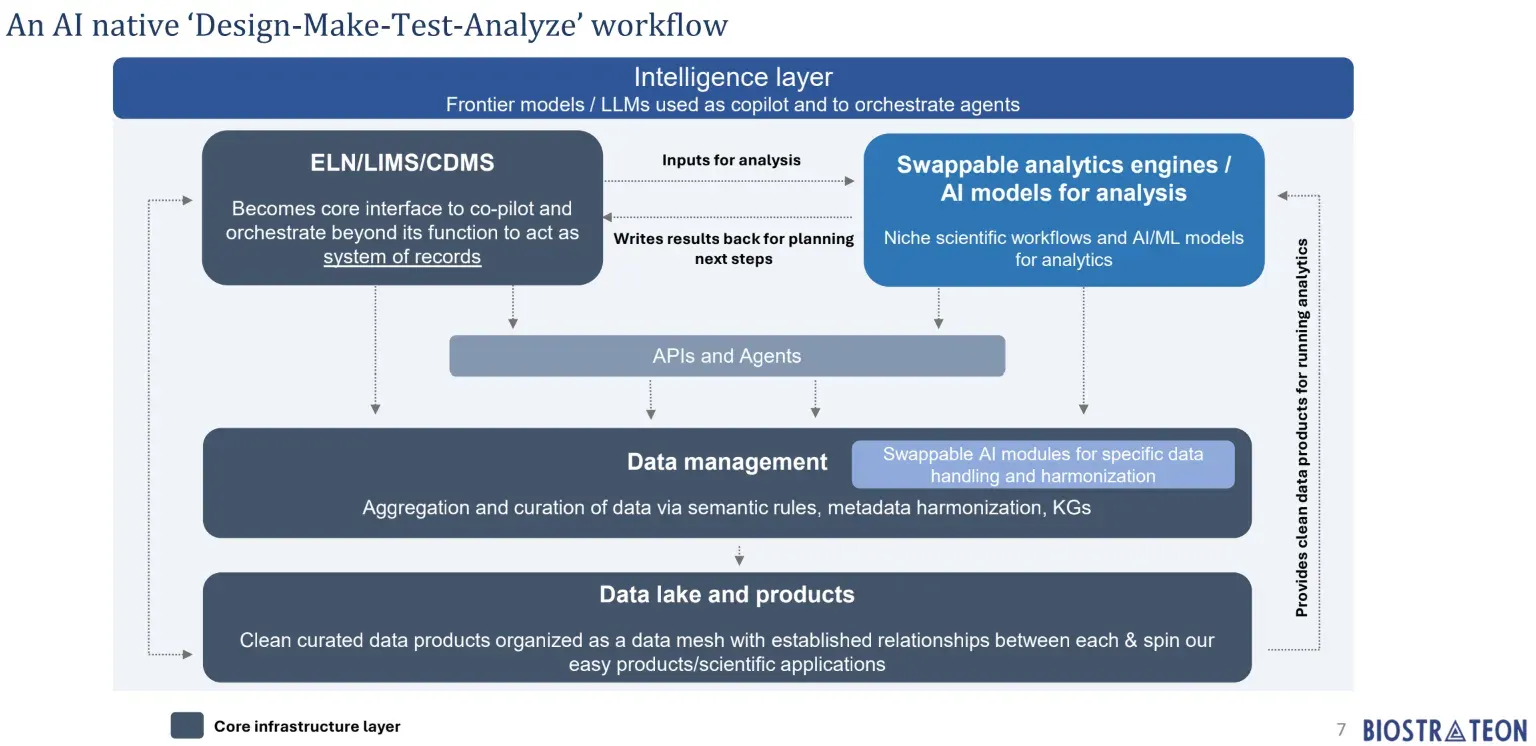
The Design-Make-Test-Analyze loop becomes a closed, AI-driven system in which agents plan experiments, orchestrate execution, harmonise data and propose the next step. Two AI layers sit on a core data infrastructure: frontier models acting as copilots and orchestrators, and domain-specific models that run scientific workflows and analysis. By 2030 we expect a few "superstacks" to emerge through consolidation, alongside an ecosystem of life science apps that makes systems easier to connect.
Where value will sit
Raw storage, generic language models and basic notebooks are becoming commodities. Defensible economics will concentrate in three layers:
An AI-aware data fabric, which is hard to replace once its schemas and ontologies are woven into customer processes.
Agentic workflow orchestration, which becomes mission-critical infrastructure and carries institutional knowledge and compliance rules.
Domain-specific workflows and models, which move scientific and business KPIs and let vendors sell outcomes rather than seats.
Market activity
M&A picked up sharply in 2025 as vendors build vertical and horizontal capabilities, while the largest players launch agentic notebooks, no-code analytics and lab operating systems with partner ecosystems. The Outlook reviews ten recent deals and the Dotmatics story: 15 acquisitions in eight years, ending in a $5.1B sale to Siemens at around 20 times revenue.
What the full Outlook covers
The PDF sets out the market sizing, the lab of the future architecture, the value-creation framework, recent deals and their integration theses, the Dotmatics case study, and our view on how software companies should reposition through partnerships, M&A and modular, agentic product design.