
Biostrat Brief

How to sell your business – A guide for founders (1/3)

  • Amandeep Singh, Ph.D.
  • 21 October 2026
  • 6 min read
M&A

Most founders spend a big portion of their life building/running their companies and go through the process of selling their company only once, and they go through it from the inside, with no reference point for what normal looks like.

And when the expectations are set from a limited know-how of the process, a lot of frustration can build up- as inevitably you will have roadblock. Just when you think that dialog with the acquirer is going well, you hit a big blow back.

Earlier this month, I spent an hour with the founder of a bootstrapped health technology company with more than a decade of product behind it. Over the past year, he had held five meetings with one of the largest service providers in his market, having an interest to acquire his company. Each meeting brought a wider group to the table: corporate development first, then strategy, then technology. At the end, the buyer decided to try building the capability in-house. A second company, in an adjacent part of the market, took his proposal to its executive team and then went quiet. Both buyers liked the technology, but no dialog progressed. I noticed his confusion and anxiety, that accompanied a silence in these conversations.

What the founder had built was a series of separate conversations, run one after another, and that structure limited what any of them could become.

We, the Advisors, investment bankers and corporate development teams, see dozens of these processes a year, and know the familiar patterns, and my hope is that by end of this 2 piece article, you would know how the process would like – when and if you choose to go down this path, and how you can position for a premium outcome.

The first part talks about how to prepare the business looking from a buyer’s lens, and the second walks through a typical process, step by step of what happens in an exit process.

Strategic preparation for the business case behind M&A

The years before:

Preparation starts long before you should be considering exit or an advisor is hired. I covered the hygiene side of this in Engineered for Exit: clean books, a diversified customer base and a management team that can run the company without the founder in every decision.

6- 12 Months before starting exit process:

Understand deeply where the company fits in the ecosystem and what it needs to grow

This section is about the strategic choices that sit on top of that hygiene. While the founder’s goal could be an exit and personal value creation, there are important actions to be taken.

The first question to ask is what does the company need for its next phase of growth that would be enabled by this transaction – Capital, Access/Distribution, Offerings Expansion.

  • If the sales and customer acquisition is a constraint, the right partner brings a channel;

  • If it is just capital, the right investor brings capital but leaves control in place;

  • If you are limited in growth because someone else owns a critical piece of value chain, the right partner supplements that.

The second question is knowing who values the company most, and why.

Each credible buyer values a company differently, because each can do different things with it. If a strategic buyer earns ten more because: they can sell you offerings to their customers and sell theirs to yours, they can pay you five of that today.

And each type of buyer will have a different strategic case behind the intent, but the basic logic remains same. A financial buyer prices on a different logic, asking what return the business itself will generate over a five- or six-year hold.

The third is relationships.

Ezra Roizen, an M&A advisor and author of The Magic Box Paradigm, argues that the strongest deals are the ones a buyer comes to see as its own idea. That takes years of contact with the executives inside the potential buyers and a possible collaboration that could make them see it as a natural fit.

Once you have understood the ecosystem and identified natural partners, you should aim to engage with their leadership once a quarter.

2-3 months before outreach to buyers: write the case from the buyer's side

Once you commit to the process, the Advisor puts together a set of documents: a short anonymous teaser; a confidential information memorandum, with three to five years of history and a forecast whose assumptions are visible; and a data room seeded with core documents before any outreach begins. But before we go into the actual process, it is important to anticipate what a buyer is looking from these materials and how are they going to build a case – so that we build strong materials.

The strongest materials answer questions from buyer's perspectives: Quality of earnings, strengths of the business, potential synergies with their business and the potential ROI case. For a financial buyer, the case is simply of an IRR, but variables differ for a strategic buyer.

How a strategic buyer builds its case

Inside a strategic buyer, every acquisition begins as a choice between building, partnering and buying. The deal case is usually built around a few questions.
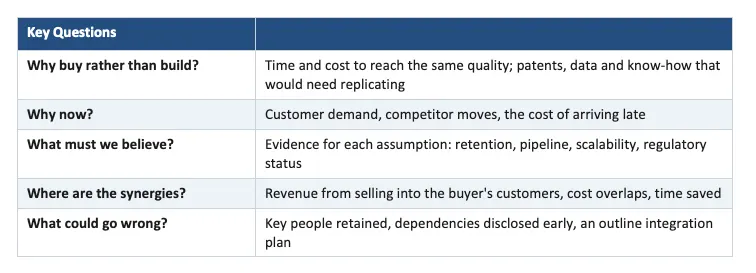
The questions a strategic buyer answers when building the deal case
  1. The first is about timing: if building the capability in-house would take years before a customer sees the product, buying shortens that timeline, and arriving late can cost the company options.

  2. The second is about advantage: corporate development teams look for where the durable edge sits, and the strongest cases combine the target’s technology with the buyer’s customers and domain depth.

  3. The team then writes down the “must-believes” that justify the deal and tests each one in diligence.

In a process I am currently close to, the buyer framed the whole evaluation as build versus buy. The acquisition case rested on showing that buying would reach the market faster than internal development, and the team made a deliberate effort to avoid “not invented here” bias.

Once those questions are answered, the case becomes a valuation.

The buyer starts with what the company is worth on its own, adds the synergies it expects to capture, and pays the seller part of that gain.

BCG found that sellers receive on average about a third of the capitalised value of expected synergies, and around half in healthcare deals. The buyer keeps the rest as its reward for carrying the integration risk.

Or to put this way: a buyer that earns ten more because of you can pay you five of that today, provided you have shown it where the ten comes from

This also explains why interest builds in stages. Each group that joins the meetings, from corporate development to strategy to the technology team that would otherwise build the product, has a stake in that internal case, and the team that would build it is often the most sceptical.

A founder who has already answered the questions in the preparation can go speed up the case.

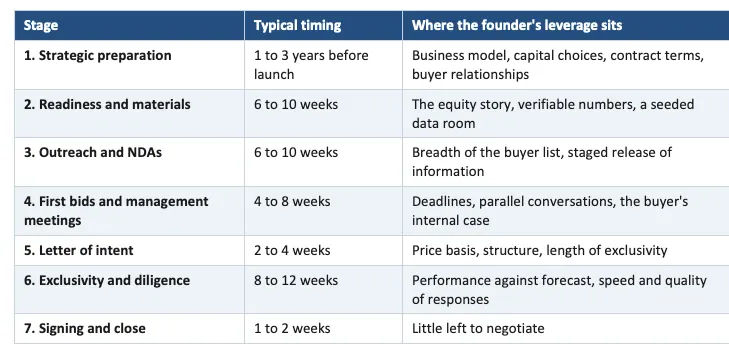
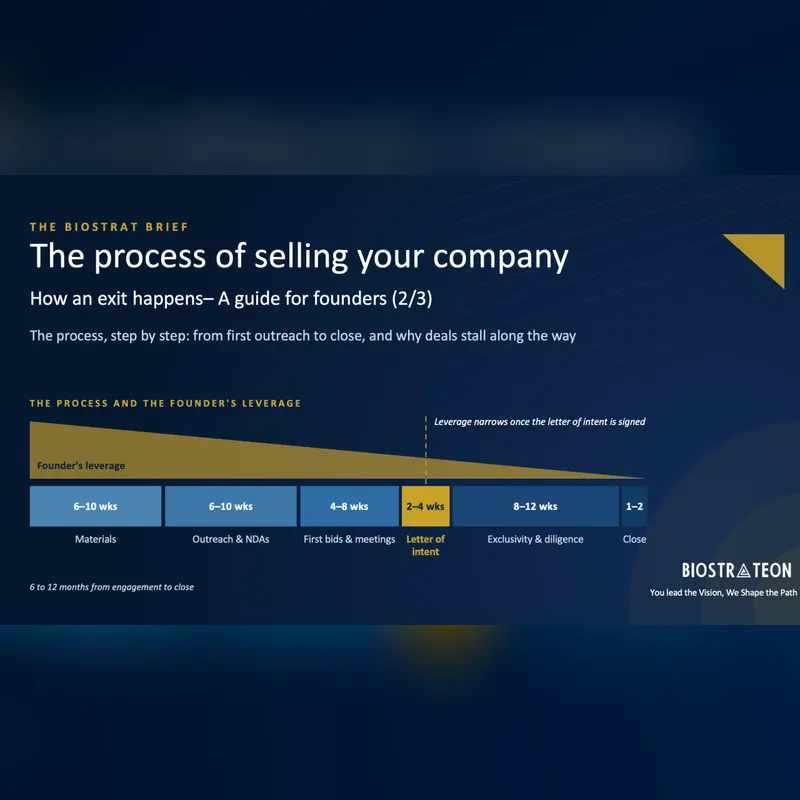
In part 2, I will walk through the steps in order, with some assumptions we practitioners use and the points where the founder can still shape the outcome.

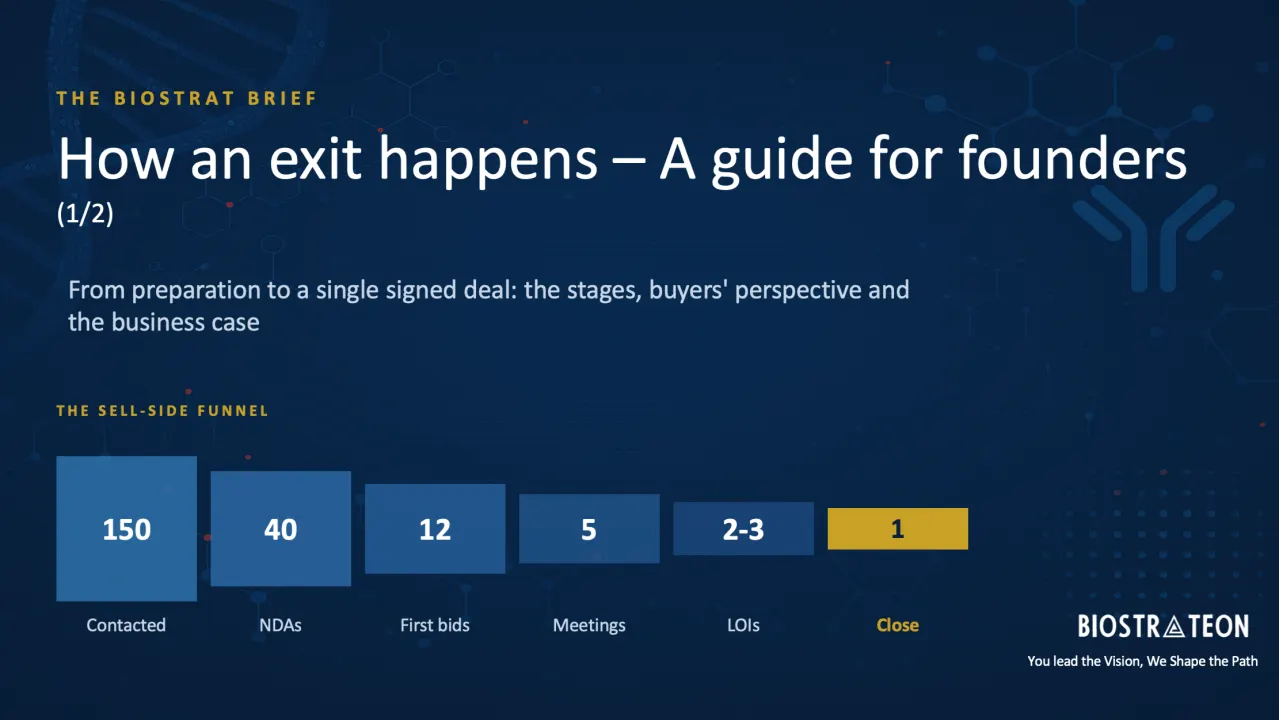
Briefly it looks like this:
The exit process funnel, from preparation to close

A founder's influence is greatest at the start of the funnel and narrows at every stage after, so the decisions that matter most are made well before anyone signs a letter of intent.

About the author

Amandeep Singh, PhD, is the Founder of BioStrateon, a life sciences and healcthcare focused advisory firm. He advises founders and investors on exits, fundraising, business-model design and M&A across drug discovery, diagnostics, clinical research technology and digital health. Reach him at info@biostrateon.com.

First published in The BioStrat Brief on LinkedIn, 21 October 2026. Subscribe to The BioStrat Brief for a dealmaker's take on M&A, fundraising, strategy and markets in life sciences.

Amandeep Singh, Ph.D.

Amandeep Singh, Ph.D.

Founder, BioStrateon

Amandeep is the Founder of BioStrateon, a boutique corporate strategy and growth advisory firm for the life sciences sector. He leverages deep domain expertise in drug discovery and dealmaking to help companies navigate capital markets, prioritise pipelines, and partner with big pharma.

View LinkedIn profile
Back to Insights

The BioStrat Brief

A dealmaker's take on M&A, fundraising, strategy and markets in life sciences and healthcare

The BioStrat Brief draws on perspectives and observations gathered through our work. Each new edition is published on LinkedIn.

Read the Brief on LinkedIn

Biostrat Brief

How to sell your business – A guide for founders (1/3)

  • Amandeep Singh, Ph.D.
  • 21 October 2026
  • 6 min read
M&A

Most founders spend a big portion of their life building/running their companies and go through the process of selling their company only once, and they go through it from the inside, with no reference point for what normal looks like.

And when the expectations are set from a limited know-how of the process, a lot of frustration can build up- as inevitably you will have roadblock. Just when you think that dialog with the acquirer is going well, you hit a big blow back.

Earlier this month, I spent an hour with the founder of a bootstrapped health technology company with more than a decade of product behind it. Over the past year, he had held five meetings with one of the largest service providers in his market, having an interest to acquire his company. Each meeting brought a wider group to the table: corporate development first, then strategy, then technology. At the end, the buyer decided to try building the capability in-house. A second company, in an adjacent part of the market, took his proposal to its executive team and then went quiet. Both buyers liked the technology, but no dialog progressed. I noticed his confusion and anxiety, that accompanied a silence in these conversations.

What the founder had built was a series of separate conversations, run one after another, and that structure limited what any of them could become.

We, the Advisors, investment bankers and corporate development teams, see dozens of these processes a year, and know the familiar patterns, and my hope is that by end of this 2 piece article, you would know how the process would like – when and if you choose to go down this path, and how you can position for a premium outcome.

The first part talks about how to prepare the business looking from a buyer’s lens, and the second walks through a typical process, step by step of what happens in an exit process.

Strategic preparation for the business case behind M&A

The years before:

Preparation starts long before you should be considering exit or an advisor is hired. I covered the hygiene side of this in Engineered for Exit: clean books, a diversified customer base and a management team that can run the company without the founder in every decision.

6- 12 Months before starting exit process:

Understand deeply where the company fits in the ecosystem and what it needs to grow

This section is about the strategic choices that sit on top of that hygiene. While the founder’s goal could be an exit and personal value creation, there are important actions to be taken.

The first question to ask is what does the company need for its next phase of growth that would be enabled by this transaction – Capital, Access/Distribution, Offerings Expansion.

  • If the sales and customer acquisition is a constraint, the right partner brings a channel;

  • If it is just capital, the right investor brings capital but leaves control in place;

  • If you are limited in growth because someone else owns a critical piece of value chain, the right partner supplements that.

The second question is knowing who values the company most, and why.

Each credible buyer values a company differently, because each can do different things with it. If a strategic buyer earns ten more because: they can sell you offerings to their customers and sell theirs to yours, they can pay you five of that today.

And each type of buyer will have a different strategic case behind the intent, but the basic logic remains same. A financial buyer prices on a different logic, asking what return the business itself will generate over a five- or six-year hold.

The third is relationships.

Ezra Roizen, an M&A advisor and author of The Magic Box Paradigm, argues that the strongest deals are the ones a buyer comes to see as its own idea. That takes years of contact with the executives inside the potential buyers and a possible collaboration that could make them see it as a natural fit.

Once you have understood the ecosystem and identified natural partners, you should aim to engage with their leadership once a quarter.

2-3 months before outreach to buyers: write the case from the buyer's side

Once you commit to the process, the Advisor puts together a set of documents: a short anonymous teaser; a confidential information memorandum, with three to five years of history and a forecast whose assumptions are visible; and a data room seeded with core documents before any outreach begins. But before we go into the actual process, it is important to anticipate what a buyer is looking from these materials and how are they going to build a case – so that we build strong materials.

The strongest materials answer questions from buyer's perspectives: Quality of earnings, strengths of the business, potential synergies with their business and the potential ROI case. For a financial buyer, the case is simply of an IRR, but variables differ for a strategic buyer.

How a strategic buyer builds its case

Inside a strategic buyer, every acquisition begins as a choice between building, partnering and buying. The deal case is usually built around a few questions.

The questions a strategic buyer answers when building the deal case
  1. The first is about timing: if building the capability in-house would take years before a customer sees the product, buying shortens that timeline, and arriving late can cost the company options.

  2. The second is about advantage: corporate development teams look for where the durable edge sits, and the strongest cases combine the target’s technology with the buyer’s customers and domain depth.

  3. The team then writes down the “must-believes” that justify the deal and tests each one in diligence.

In a process I am currently close to, the buyer framed the whole evaluation as build versus buy. The acquisition case rested on showing that buying would reach the market faster than internal development, and the team made a deliberate effort to avoid “not invented here” bias.

Once those questions are answered, the case becomes a valuation.

The buyer starts with what the company is worth on its own, adds the synergies it expects to capture, and pays the seller part of that gain.

BCG found that sellers receive on average about a third of the capitalised value of expected synergies, and around half in healthcare deals. The buyer keeps the rest as its reward for carrying the integration risk.

Or to put this way: a buyer that earns ten more because of you can pay you five of that today, provided you have shown it where the ten comes from

This also explains why interest builds in stages. Each group that joins the meetings, from corporate development to strategy to the technology team that would otherwise build the product, has a stake in that internal case, and the team that would build it is often the most sceptical.

A founder who has already answered the questions in the preparation can go speed up the case.

In part 2, I will walk through the steps in order, with some assumptions we practitioners use and the points where the founder can still shape the outcome.

Briefly it looks like this:

The exit process funnel, from preparation to close

A founder's influence is greatest at the start of the funnel and narrows at every stage after, so the decisions that matter most are made well before anyone signs a letter of intent.

About the author

Amandeep Singh, PhD, is the Founder of BioStrateon, a life sciences and healcthcare focused advisory firm. He advises founders and investors on exits, fundraising, business-model design and M&A across drug discovery, diagnostics, clinical research technology and digital health. Reach him at info@biostrateon.com.

First published in The BioStrat Brief on LinkedIn, 21 October 2026. Subscribe to The BioStrat Brief for a dealmaker's take on M&A, fundraising, strategy and markets in life sciences.
Amandeep Singh, Ph.D.

Amandeep Singh, Ph.D.

Founder, BioStrateon

Amandeep is the Founder of BioStrateon, a boutique corporate strategy and growth advisory firm for the life sciences sector. He leverages deep domain expertise in drug discovery and dealmaking to help companies navigate capital markets, prioritise pipelines, and partner with big pharma.

View LinkedIn profile
Back to Insights

The BioStrat Brief

A dealmaker's take on M&A, fundraising, strategy and markets in life sciences and healthcare

The BioStrat Brief draws on perspectives and observations gathered through our work. Each new edition is published on LinkedIn.

Read the Brief on LinkedIn

Biostrat Brief

How to sell your business – A guide for founders (1/3)

  • Amandeep Singh, Ph.D.
  • 21 October 2026
  • 6 min read
M&A

Most founders spend a big portion of their life building/running their companies and go through the process of selling their company only once, and they go through it from the inside, with no reference point for what normal looks like.

And when the expectations are set from a limited know-how of the process, a lot of frustration can build up- as inevitably you will have roadblock. Just when you think that dialog with the acquirer is going well, you hit a big blow back.

Earlier this month, I spent an hour with the founder of a bootstrapped health technology company with more than a decade of product behind it. Over the past year, he had held five meetings with one of the largest service providers in his market, having an interest to acquire his company. Each meeting brought a wider group to the table: corporate development first, then strategy, then technology. At the end, the buyer decided to try building the capability in-house. A second company, in an adjacent part of the market, took his proposal to its executive team and then went quiet. Both buyers liked the technology, but no dialog progressed. I noticed his confusion and anxiety, that accompanied a silence in these conversations.

What the founder had built was a series of separate conversations, run one after another, and that structure limited what any of them could become.

We, the Advisors, investment bankers and corporate development teams, see dozens of these processes a year, and know the familiar patterns, and my hope is that by end of this 2 piece article, you would know how the process would like – when and if you choose to go down this path, and how you can position for a premium outcome.

The first part talks about how to prepare the business looking from a buyer’s lens, and the second walks through a typical process, step by step of what happens in an exit process.

Strategic preparation for the business case behind M&A

The years before:

Preparation starts long before you should be considering exit or an advisor is hired. I covered the hygiene side of this in Engineered for Exit: clean books, a diversified customer base and a management team that can run the company without the founder in every decision.

6- 12 Months before starting exit process:

Understand deeply where the company fits in the ecosystem and what it needs to grow

This section is about the strategic choices that sit on top of that hygiene. While the founder’s goal could be an exit and personal value creation, there are important actions to be taken.

The first question to ask is what does the company need for its next phase of growth that would be enabled by this transaction – Capital, Access/Distribution, Offerings Expansion.

  • If the sales and customer acquisition is a constraint, the right partner brings a channel;

  • If it is just capital, the right investor brings capital but leaves control in place;

  • If you are limited in growth because someone else owns a critical piece of value chain, the right partner supplements that.

The second question is knowing who values the company most, and why.

Each credible buyer values a company differently, because each can do different things with it. If a strategic buyer earns ten more because: they can sell you offerings to their customers and sell theirs to yours, they can pay you five of that today.

And each type of buyer will have a different strategic case behind the intent, but the basic logic remains same. A financial buyer prices on a different logic, asking what return the business itself will generate over a five- or six-year hold.

The third is relationships.

Ezra Roizen, an M&A advisor and author of The Magic Box Paradigm, argues that the strongest deals are the ones a buyer comes to see as its own idea. That takes years of contact with the executives inside the potential buyers and a possible collaboration that could make them see it as a natural fit.

Once you have understood the ecosystem and identified natural partners, you should aim to engage with their leadership once a quarter.

2-3 months before outreach to buyers: write the case from the buyer's side

Once you commit to the process, the Advisor puts together a set of documents: a short anonymous teaser; a confidential information memorandum, with three to five years of history and a forecast whose assumptions are visible; and a data room seeded with core documents before any outreach begins. But before we go into the actual process, it is important to anticipate what a buyer is looking from these materials and how are they going to build a case – so that we build strong materials.

The strongest materials answer questions from buyer's perspectives: Quality of earnings, strengths of the business, potential synergies with their business and the potential ROI case. For a financial buyer, the case is simply of an IRR, but variables differ for a strategic buyer.

How a strategic buyer builds its case

Inside a strategic buyer, every acquisition begins as a choice between building, partnering and buying. The deal case is usually built around a few questions.

The questions a strategic buyer answers when building the deal case
  1. The first is about timing: if building the capability in-house would take years before a customer sees the product, buying shortens that timeline, and arriving late can cost the company options.

  2. The second is about advantage: corporate development teams look for where the durable edge sits, and the strongest cases combine the target’s technology with the buyer’s customers and domain depth.

  3. The team then writes down the “must-believes” that justify the deal and tests each one in diligence.

In a process I am currently close to, the buyer framed the whole evaluation as build versus buy. The acquisition case rested on showing that buying would reach the market faster than internal development, and the team made a deliberate effort to avoid “not invented here” bias.

Once those questions are answered, the case becomes a valuation.

The buyer starts with what the company is worth on its own, adds the synergies it expects to capture, and pays the seller part of that gain.

BCG found that sellers receive on average about a third of the capitalised value of expected synergies, and around half in healthcare deals. The buyer keeps the rest as its reward for carrying the integration risk.

Or to put this way: a buyer that earns ten more because of you can pay you five of that today, provided you have shown it where the ten comes from

This also explains why interest builds in stages. Each group that joins the meetings, from corporate development to strategy to the technology team that would otherwise build the product, has a stake in that internal case, and the team that would build it is often the most sceptical.

A founder who has already answered the questions in the preparation can go speed up the case.

In part 2, I will walk through the steps in order, with some assumptions we practitioners use and the points where the founder can still shape the outcome.

Briefly it looks like this:

The exit process funnel, from preparation to close

A founder's influence is greatest at the start of the funnel and narrows at every stage after, so the decisions that matter most are made well before anyone signs a letter of intent.

About the author

Amandeep Singh, PhD, is the Founder of BioStrateon, a life sciences and healcthcare focused advisory firm. He advises founders and investors on exits, fundraising, business-model design and M&A across drug discovery, diagnostics, clinical research technology and digital health. Reach him at info@biostrateon.com.

First published in The BioStrat Brief on LinkedIn, 21 October 2026. Subscribe to The BioStrat Brief for a dealmaker's take on M&A, fundraising, strategy and markets in life sciences.
Amandeep Singh, Ph.D.

Amandeep Singh, Ph.D.

Founder, BioStrateon

Amandeep is the Founder of BioStrateon, a boutique corporate strategy and growth advisory firm for the life sciences sector. He leverages deep domain expertise in drug discovery and dealmaking to help companies navigate capital markets, prioritise pipelines, and partner with big pharma.

View LinkedIn profile
Back to Insights

The BioStrat Brief

A dealmaker's take on M&A, fundraising, strategy and markets in life sciences and healthcare

The BioStrat Brief draws on perspectives and observations gathered through our work. Each new edition is published on LinkedIn.

Read the Brief on LinkedIn