The BioStrat Brief · Amandeep Singh, Ph.D. ·
The Discipline of Engineering a Lucrative Exit
Exits are engineered years before the data room opens. Seven self-inflicted mistakes that quietly kill life sciences deals, and the timeline that avoids them.
Most founders picture the exit as a singular moment: a term sheet on the table, a room full of stakeholders, a single number to push higher. That glamorous picture as comforting as it may seem is almost entirely wrong.
By the time everyone is in the room, the outcome has largely already been decided. Over the 7 years of deal-making, I have watched dialogs collapse, even when both sides wanted to work together. I have also seen deals close at a lower valuation than what the underlying science and business deserved. They were rarely lost in negotiation; the millions of dollars were left on the table some time earlier in the journey, in a series of small, avoidable decisions that nobody flagged as strategic at the time.
Across the mandates I have run and witnessed - successful M&As, fundraising, licensing & collaboration deals, and the harder-to-talk-about cases where we simply could not find the right partner or watched money left on the table to poor market timing, the same pattern keeps surfacing.
Founders blame the market for a disappointing exit far more often than the market deserves it. While a lot depends on it, most of the damage is home-brewed. An exit should be strategically engineered, not negotiated.
Here are some unwilling mistakes founders make and how to avoid them. Sharing first hand experiences from my own work.
Self-inflicted mistakes that quietly kill deals, and ways to avoid them
1. Treating the exit as an event rather than a discipline
The first mistake sits underneath all the others. Founders treat “planning for exit” as something that begins when a banker is hired or when an acquirer knocks the door. When in reality, it is a multi-year operating discipline that should begin the moment real money starts flowing or around Series A.
Start late and every subsequent problem compounds. You cannot clean and audit three years of expenses in a quarter. You cannot manufacture a diversified customer base the month before diligence. You cannot retrofit an autonomous management team into a company that has run on one person’s instincts. The founders who exit well are not the ones who negotiate hardest at the end; they are the ones who spent years removing reasons for a buyer to say no. Exit readiness is not a last minute plan you create, it is a way you have built the company, with every decision compounding.
2. Paying later for the premium - Raising at a valuation your exits can't clear
Every founder hopes to raise capital at the highest valuations markets can provide. Sometimes, there is a quiet cost to raising at a rich valuation, and it lands years later, at exit. A high post-money is not a trophy; it is a hurdle rate you have handed your investors. Every dollar raised at an inflated price resets the return they must clear for the fund math to work.
Market cycles sharpen the trap: the premium you capture in a hot window becomes the anchor you are measured against once capital tightens and multiples compress.
A micro-physiological device platform company raised $8.5M at an $85M post-money in 2021, peak COVID hype. Unfortunately, due to technical challenges, they had to pivot into platform based services. For specialized services, the market pays only 4-8x revenue. We tried to acquire the company twice, in 2024 and 2025, and the founders wanted to sell. While the revenue increased from $7M to $11M; the multiples didn’t return any gains to the investors.
The discipline is to price each round against the exits your category actually produces, not the ones the headlines celebrate, because the valuation you are proudest of raising at is the one your investors will one day need you to beat.
3. Creating an arbitrary finish line when markets don’t
A common mistake I see is an arbitrary benchmark the founder(s) have decided must be crossed before selling: a round number of revenues, a headcount, a marquee logo, a new product type - treated as a law of nature rather than a preference.
A multi-OMICs platform-plus-services company had a genuine window. On roughly $7M of 2022 revenue it was offered $24M — about 3.5x revenue. As revenue grew to $8.5M in 2023, the offer improved to $34M, roughly 4x. The founders held out for more. In 2024 revenue slipped to $6M and the interested buyer came back only “warm.” By 2025, at $5.2M and with the market mood turned, the company was willing to sell for $10M, less than a third of the number it had turned down two years earlier.
Nothing about the science broke. The external multipliers moved: cash in the market, the cost of money, sector momentum. These forces swing deal values more than founders like to admit, and they are almost entirely outside your control. The flaw in an arbitrary target is that it is denominated in your progress while the offer is denominated in the market’s appetite and the two do not run on the same clock.
Hitting your desired number an year later is futile if the buyers have moved on from your space; you finally cross the line with nobody in sight on the other side of it. A strong offer in a strong market is not a floor you can always improve on, it is often the ceiling, and the ceilings collapse many times.
4. Messy math
The most avoidable sin, and the one that does damage unproportioned to its size, is sloppy financial hygiene. Acquirers do not just underwrite your revenue; they underwrite their confidence that your numbers are real. Every mistake in the books is read as a question about everything else.
Not too long ago, we evaluated a single-founder bootstrapped business in medical affairs. The founder’s personal car expensed on the P&L and two family members on payroll to reduce tax, neither with any role in the business. Individually, small items. Together, they told our client that the financials were an instrument of tax management rather than a faithful picture of the business.
Co-mingled personal and business expenses are not a book-keeping issue. They are a valuation issue.
5. Client concentration
Revenue quality matters more than revenue level, and nothing degrades quality faster than concentration.
An AI-drug discovery company selling a mix of SaaS and services came to market with its largest client contributing 55% of revenue, with top 2 clients accounting for 90% of revenue. We did put an offer, but we did underwrite the entire deal around those 2 relationships: payouts were made contingent on that account continuing for three years post-close.
The founders had unknowingly handed a chunk of their consideration to the retention behaviour of one customer they no longer fully controlled. Concentration does not just cap your multiple; it moves your money out of your hands and makes it someone else’s to lose.
6. The celebrity founder
The trait that builds an early-stage company - a founder who is in every decision, every account, every room, becomes a liability precisely when you want to sell. Buyers are not acquiring a person; they are acquiring a system that survives that person’s departure.
At one clinical-trial technology company, a founder had been quietly overstepping the sales team and running key accounts personally. It surfaced, as these things do, over dinner during diligence, when the sales team let slip that they were ready to leave the moment a deal closed. The acquirer’s entire thesis rested on that commercial team. What looked like founder dedication read to the buyer as key-person risk and a hollow organization underneath the founder.
7. The business-model muddle
The most structural mistake, and the hardest to reverse, is letting the business model blur. In the biotech sector, the model dictates the buyer. A pure SaaS or platform-licence company is valued as a software business and finds a home with another techbio or a software acquirer. A services business is valued as a technology-driven CRO and sells to a CRO or CDMO. An asset or pipeline business is valued as a biotech and exits to pharma, a licensing deal, or the public markets. Each clean model maps to a distinct, well-worn exit pathway and a distinct valuation logic, and the spread between them is enormous.
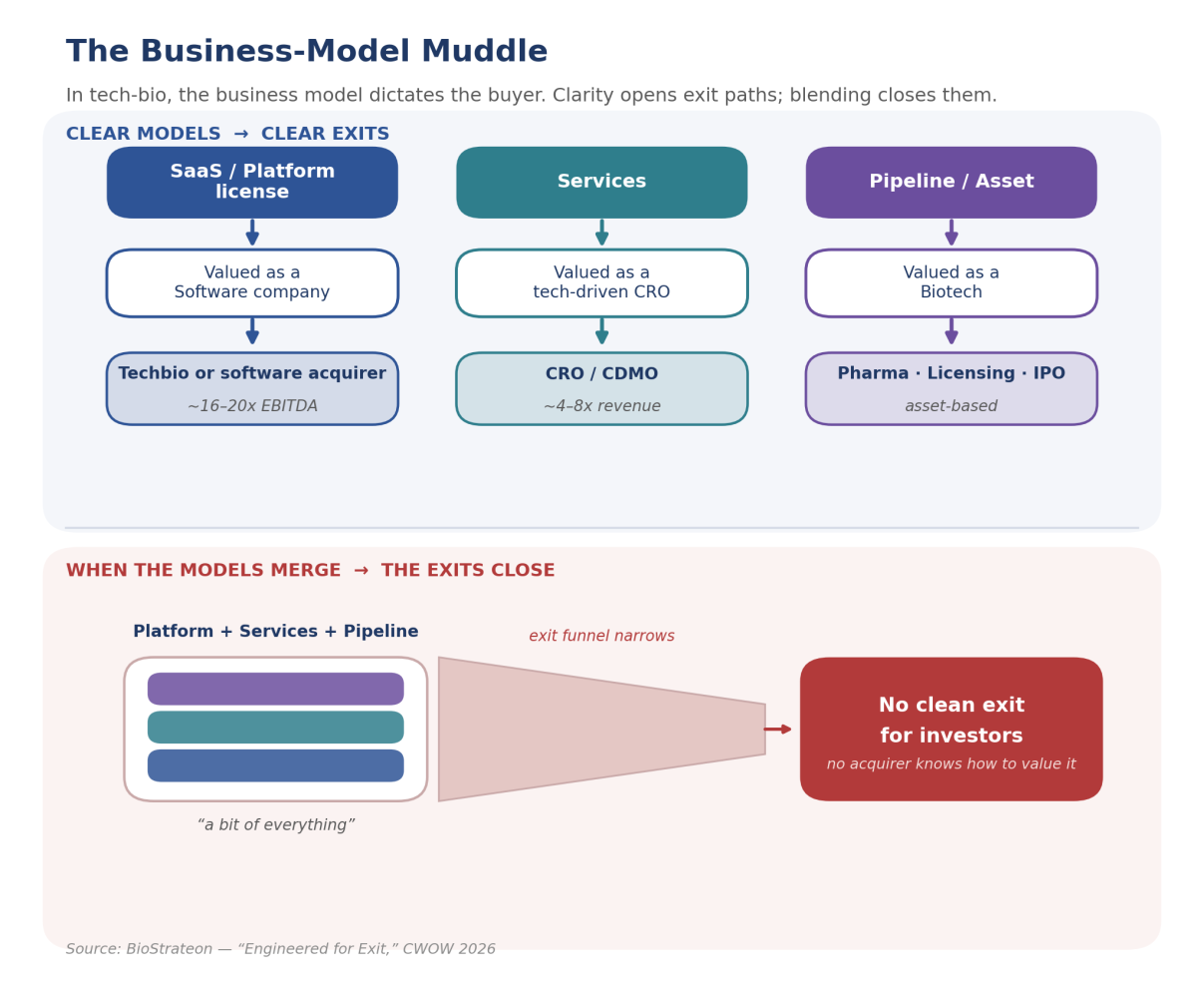
The trouble starts when founders, chasing every available dollar, merge these models: a bit of platform licence, a bit of co-discovery, a services line, an internal pipeline. Each addition feels like de-risking.
Collectively they narrow the exit funnel, because no single acquirer knows how to value the blend or which of their playbooks to apply. Layer in messy, diverging cash-flow structures across licence upfronts, milestones, royalties, and fixed-fee services, and stakeholders with misaligned time horizons, and you arrive at the worst outcome of all: a company that generates cash but offers no clean exit for its investors. The model that maximises optionality in year two can eliminate it by year five.
Engineering the exit: the discipline that works
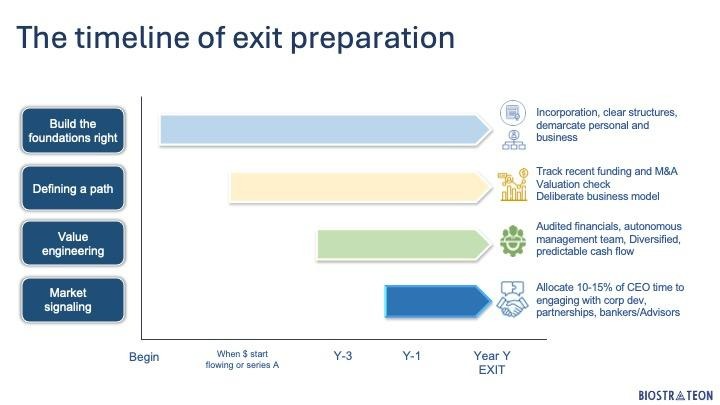
The good news is that every one of these items is a decision, which means each has a better decision available. Reverse-engineer from the exit and the timeline is clear.
Foundational:
Incorporate cleanly, build clear corporate structures, and demarcate personal from business from day one.
Around three years out or, in practice, when the money starts flowing or at Series A:
Make the business model a deliberate choice rather than an accident of which collaboration happened to be easiest, because that single decision fixes your buyer universe and your multiple.
Diversify the revenue base so no single account can hold your consideration hostage and make the cash flow predictable.
Track recent funding rounds and comparable M&A in your space so your sense of value stays anchored to the market rather than to hope. Run a valuation check against reality.
Ideally build relationships in some of partnerships with the potential buyers.
About a year out, the work turns operational:
Get to audited financials.
Build an autonomous management team that can run the company, and be seen to run it, without the founder in every decision.
CEOs should spend 10–15% of their time engaging corporate development, potential partners, and bankers or advisors well before any process begins. so that when the moment comes, the buyers already know you, and you already know what you are worth.
Do this so that, when the day finally arrives, there are few surprises.
An exit is not, at its core, a negotiation you win at the end
The forces founders love to blame- the market, the multiple, the buyer’s mood are all real. But what is also real is a set of unglamorous, entirely controllable decisions about hygiene, concentration, organizational depth, timing discipline, and model clarity, made years before anyone opens a data room. The founders who understand that they are engineering the exit from the very first dollar are the ones who get to choose their ending. The rest are left explaining, over a diligence dinner, why the number just fell.
About the author
Amandeep Singh, Ph.D., is the Founder of BioStrateon, a boutique corporate strategy and growth advisory firm for the life sciences sector. He advises tech-bio founders and investors on exits, fundraising, business-model design, and M&A across drug discovery and diagnostics. Reach him at info@biostrateon.com.
First published in The BioStrat Brief on LinkedIn, 21 July 2026. Subscribe to The BioStrat Brief for a dealmaker's take on M&A, fundraising, strategy and markets in life sciences.