The BioStrat Brief · Parul Budhraja Khanna, MBA ·
The Pharma Commercial Services Model that Worked for Decades is Rewiring: Decision Every CEO is now Sitting On
Agentic AI is repricing the seat between pharma's commercial intent and customer behaviour. Which layers of commercial services melt, which survive, and what the deal tape says.
Every few years, life sciences gets a technology wave that promises to rewrite the economy underneath it. Genomics did it to diagnostics. Cloud did it to clinical data management. This time around, it's agentic AI in the pharma commercial value chain, and unlike earlier waves, this one won't give you a decade to watch and wait. The winners will be evident within 24 months.
The conventional narrative says this is an efficiency story, wherein, AI makes delivery cheaper, margins improve, firms that adopt early win. This is true but dangerously incomplete. It misses the deeper transaction-level truth. What is being repriced is not the cost-of-service delivery, but the right to sit between a pharma company's commercial intent and its customer's behaviour. Whoever owns that seat owns the economics of everything flowing through it. The services industry has spent two decades selling advice and execution around that seat. Agentic AI is that technology which is capable of occupying it, not advising around it but sitting in it.
The deal table below is a confirmation that the Agentic wave hasn't gone unnoticed by the markets. It is not a quiet disruption but one that is loud and announced in varied press releases almost every month.
Why the Model Sustained So Far and Why is it Breaking Now!
Pharma commercial services have always been discretionary judgment intensive, relationship driven, choosing a piecemeal approach to get ‘best of breed’ offerings across the value chain. A drug launch requires tight coordination of commercial strategy, market access, medical affairs and field teams. The model worked because the value of knowing which HCP to call or how to prove a particular outcome was locked inside people: experienced MSLs, seasoned payer strategists, HEOR scientists who had spent careers encoding market access logic into their instincts.
Underneath that sat a structural asymmetry: enormous investment in clinical evidence generation and a chronic lag in how that evidence reaches the right HCPs and patients at the right moment. Historically, internal pharma teams managed this coordination and judgment while relying on siloed insights from external specialists, a fragmented process that took months to turn insights into targeted HCP or patient messaging.
Agentic AI has Enabled 2 Things that are Breaking this Process Simultaneously
First, the knowledge is moving from heads into products
Evidence synthesis, HCP targeting, content personalization, call planning, market access modelling, each of these is being rebuilt ground-up by AI-native platforms that are faster, capture real-time data and increasingly more accurate than the legacy model. The knowledge that used to live in a person's head is being transferred into a product. And products, unlike people, scale!
Second, agentic AI removes data re-platforming and harmonization tax
For years, every pharma company built its own way of organizing commercial data: its own categorization logic, its own ontology for what a qualified HCP touchpoint means, its own definitions baked into CRM and warehouse structures. Previous platform waves demanded migration into the vendor's schema before delivering a single insight, which is precisely why a custom tech-and-analytics services industry existed to bridge the gap, and why black-box SaaS pitches kept dying in pharma procurement.
Agentic systems reason across disparate, siloed sources through integration protocols, working with the data as it already exists. The platforms winning mandates today deploy in the client's environment, on the client's data logic, and gatekeep who sees what: the HQ strategy view, the field MSL view, the sales manager view, without a six-month integration project. That is a more durable differentiation than output quality, because it solves for trust, operational fit and it removes the very friction that protected the services model.
Pharma Commercial Market: Three Layers, Three Very Different Fates
This change will drive a structural re-sorting of the market over the next 3-5 years:
1. The execution layer will reprice, permanently
Content generation, standard analytics, templated medical communications, routine reporting. The cost to deliver this layer is collapsing as agentic workflows automate what used to require analyst hours. Services firms deriving significant revenue here without owning the tech that delivers it will face disruption. This won't be extinction; the work will still get done but it’ll get repriced and the price pressure will not reverse.
2. The judgment layer survives; thinner, deeper and connected
HEOR strategy, regulatory submissions, KOL relationship management, novel payer negotiation, primary market research. A payer does not negotiate formulary access with a platform. They negotiate with a person who has a relationship and is accountable for being wrong. This layer cannot be productized (yet) not because AI is not capable enough but because the value of it is inseparable from human accountability and institutional trust. This layer remains genuinely defensible services revenue, albeit connected with intelligence that accelerates it.
3. The middle - orchestration and intelligence layer is where the war is and where the opportunity to build a moat lives.
Next-best-action, channel orchestration, HCP journey optimization, payer intelligence synthesis, field force optimization. This is the action layer between the intent and behavior. Owning it requires three things that are genuinely hard to replicate: proprietary data, orchestration excellence and compliance architecture.
Compliance in pharma commercial used to be a cost center managed through training, SOPs and human review. MLR complexity, off-label guardrails, and evolving FDA guidance on AI-generated promotional content have now made compliance-by-design a genuine competitive weapon, baked into software architecture, not bolted on through process.
The Deal Tape Validates It: Players are Moving to Own ‘Outcome’ instead of ‘Capabilities’
Pharma commercial was never a one-vendor market, clients diversify risk across providers, and that isn't changing. What's changing is what it takes to defend a position within a single segment. A medcomms firm can no longer hold its ground on strategy and content quality alone. It will now have to own the full stack inside its segment; positioning, generation, MLR workflow, field enablement, and the analytics that prove what worked. The same dynamic is running inside market access, inside HCP engagement, inside patient services and so on.
If you look at the recent M&As in the space, a clear pattern shows up.
Every meaningful deal pairs a company to own execution and outcome across a channel. They are tying together intelligence, strategy, data, content and engagement to provide the client an outcome across a channel, whether it is HCPs, patients or field teams.
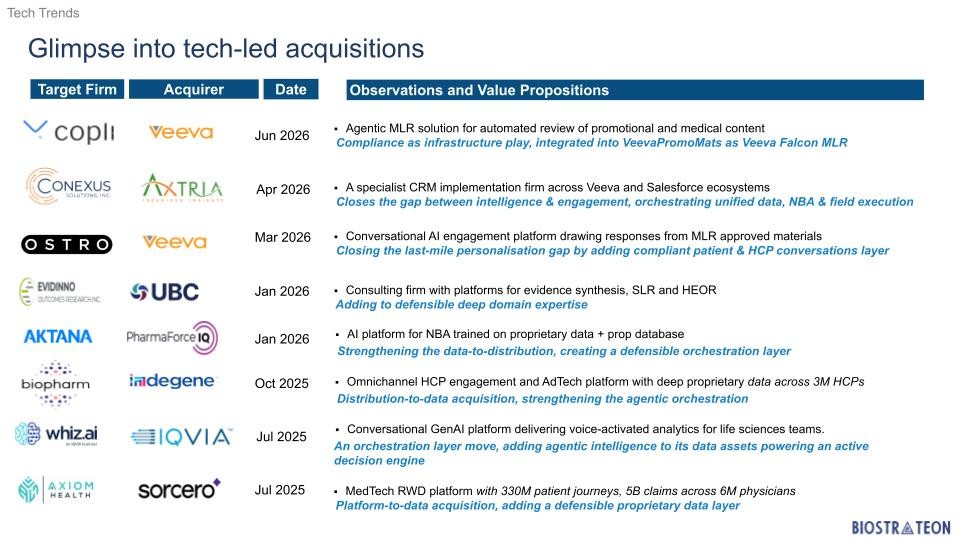
This shows the real race isn’t just about who has the best tech enablement but also who controls a genuine channel and has a real proof of what works through it. Which exposes the strategic error many mid-size incumbents are making right now: treating AI tooling as the asset to be acquired, when the tooling is the abundant part. Intelligence gets better every quarter whether you invest in it or not. What's scarce is the data the intelligence runs on and the distribution it acts through. Capital is currently chasing companies with slick agentic interfaces; the sophisticated acquirers are quietly assembling channel-plus-data positions.
The Executive Decision: Window to Act is Shorter than the Planning Cycle this time
If you run a strategy-led services firm, the sequence is: Identify your actual moat; proprietary data, client relationships, or genuinely scarce domain judgment; most firms have at least one. Map which of your revenue sits in which layer, honestly, that tells you what's melting and what's defensible. Then locate your real gap. Most services CEOs assume their gap is technology. It usually isn't. Technology gaps in commoditizing capabilities can be partnered or licensed cheaply. The gaps worth acquiring for are data and distribution - the scarce components. Build, partner, or acquire accordingly, and do it inside a window that is now shorter than most firms' planning cycles.
If you run a tech-platform company, three honest questions. First, which layer are you actually in? Early traction in the execution layer is real revenue and a fake moat. Second, what's your genuine bottleneck? It is almost never model quality and almost always enterprise procurement, compliance validation, or deployment friction; problems a bigger sales team doesn't fix but a distribution partner with trusted client relationships does. Third, what are you compounding? If usage of your platform is building a proprietary outcome-data asset, you're building toward the action layer, and every quarter makes it harder to displace. If it isn't, you are, whether you intend it or not, optimizing to be acquired as a feature or revenue center and you should at least price yourself accordingly.
Our view
This is not, at bottom, a story about adopting technology. It is a contest over who ends up owning the seat between a pharma company's commercial intent and its customer's behavior: fought with data and distribution, defended with compliance architecture, and already visible on the deal tape for anyone listening. The firms that see that clearly, on either side of a transaction, will structure better deals and avoid the integration failures that defined the last decade of pharma tech M&A.
About the author: Parul Budhraja Khanna is a Senior Consultant at BioStrateon, working at the tech intersection of life sciences, diagnostics, and healthcare delivery, helping ambitious concepts land as functioning ventures. Her global background covers both early-stage venture-building and execution at institutional scale. That's included supporting the launch of AI-enabled platforms and taking healthcare infrastructure from early concept to operational reality. Her focus stays on the space between scientific promise and commercial discipline, converting technical potential to results on the ground.
First published in The BioStrat Brief on LinkedIn, 7 July 2026. Subscribe to The BioStrat Brief for a dealmaker's take on M&A, fundraising, strategy and markets in life sciences.