The BioStrat Brief · Amandeep Singh, Ph.D. ·
The changing wave of AI adoption in pharma: From molecules to models
Pharma has moved from partnering for AI-made molecules to licensing models and owning the capability. Rent, build or buy: how to choose, and what it means for techbio.
Eighteen months ago, if you asked a large-cap pharma how it "did AI," the honest answer was: sign a licensing/co-discovery deal and then wait. The AI sat on the other side of a contract. The molecules, if they ever came, arrived as milestones.
The recent wave tells a new story.
In the space of two years, AI has moved from something pharma buys the output of to something it licenses, builds, and owns. The deal structures tell the story better than any keynote, because structure is where conviction shows up.
Wave I: Partner for the Pipeline (2023–2024)
The first wave was a pipeline play. Pharma treated AI platforms the way it treats any early-stage biotech: option it, milestone it, keep the cash at risk small.
The signature deals were collaborations, not acquisitions. Lilly and Novartis each backed Isomorphic Labs for de novo small-molecule programmes worth, on paper, well over a billion dollars apiece. Roche put up to $1.05B behind Dyno's AI-designed gene-therapy capsids. Novartis pledged around $1.07B to Generate Biomedicines for protein design, and layered a molecular-glue collaboration onto Monte Rosa. When two of the original "AI-first" platforms ran short of clinical proof, they merged, Recursion absorbed Exscientia in late 2024, the field's one clean act of consolidation.
Most of these these deals rhyme under the hood. A modest upfront and a mountain of contingent Biobucks. Pharma was buying shots on goal, not conviction. It could point to the upside without committing to it. The structure was optionality, dressed as partnership.
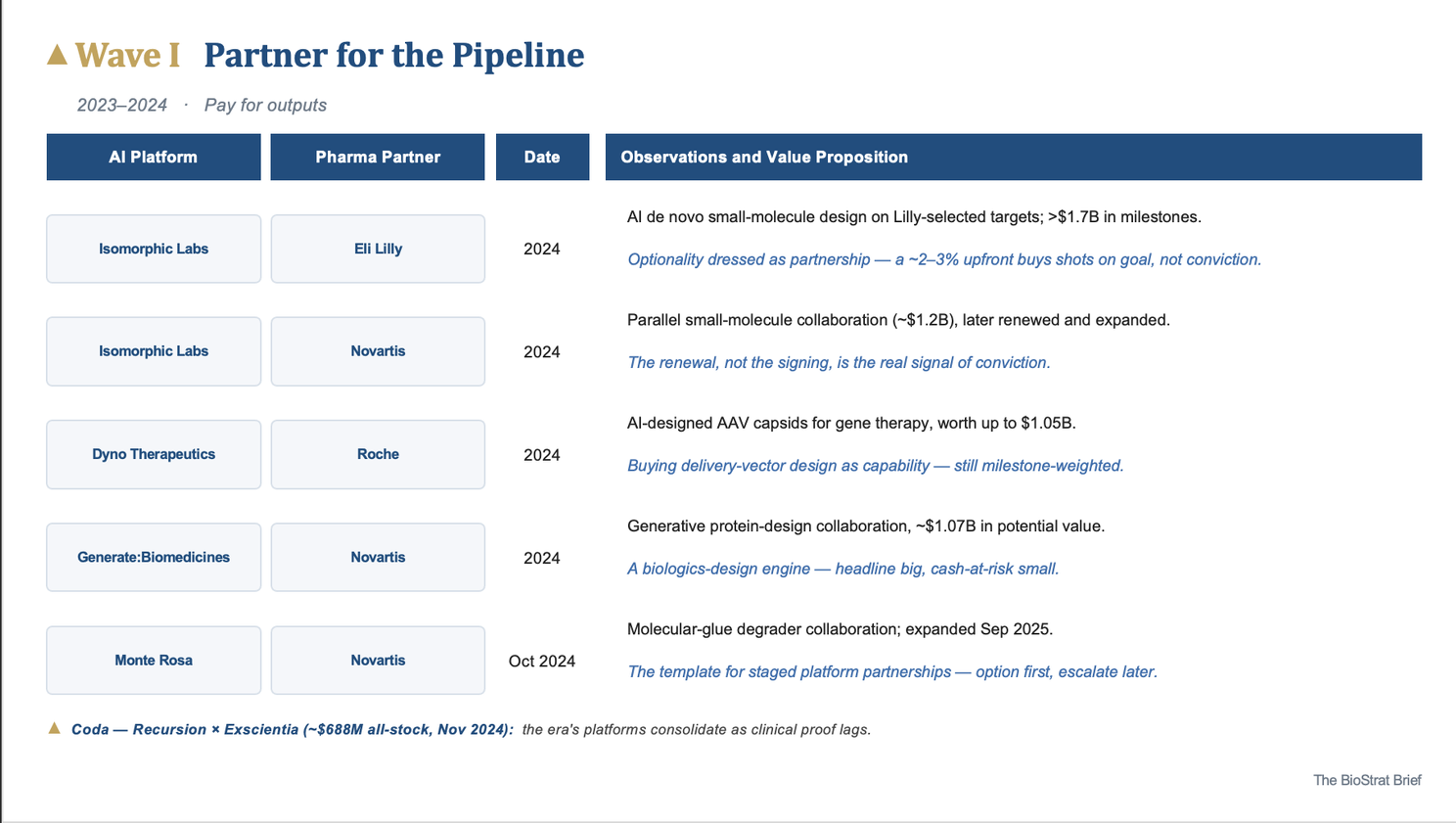
One thing pharma definitely got from these deals, was learn all about AI so that they can build up internal teams and infrastructure better, and that led to what we see now.
The new wave: License the Models (2025–2026)
In the last year or so, pharma stopped asking AI platforms for molecules and started asking for the models themselves.
The cleanest example is GSK–Noetik, January 2026: a five-year, non-exclusive licence to Noetik's virtual-cell foundation models: a $50M upfront and, the important part, annual subscription fees. Not biobucks. A SaaS line item, inside a pharma R&D budget. People in the field called it the first true model-licensing deal in techbio, and they were right to notice.
Then, It wasn't a one-off.
Pfizer struck a deal with Boltz to fine-tune its open foundation models on Pfizer's own historical data- Pfizer keeps every molecule that comes out. Chai Discovery signed multiple pharma customers in under seven months: Lilly, Pfizer, Novartis, and BMS: selling model access, not drug candidates. Incyte licensed its experimental data to train Genesis's models and kept the drug rights. The molecule was no longer the product. The model was.
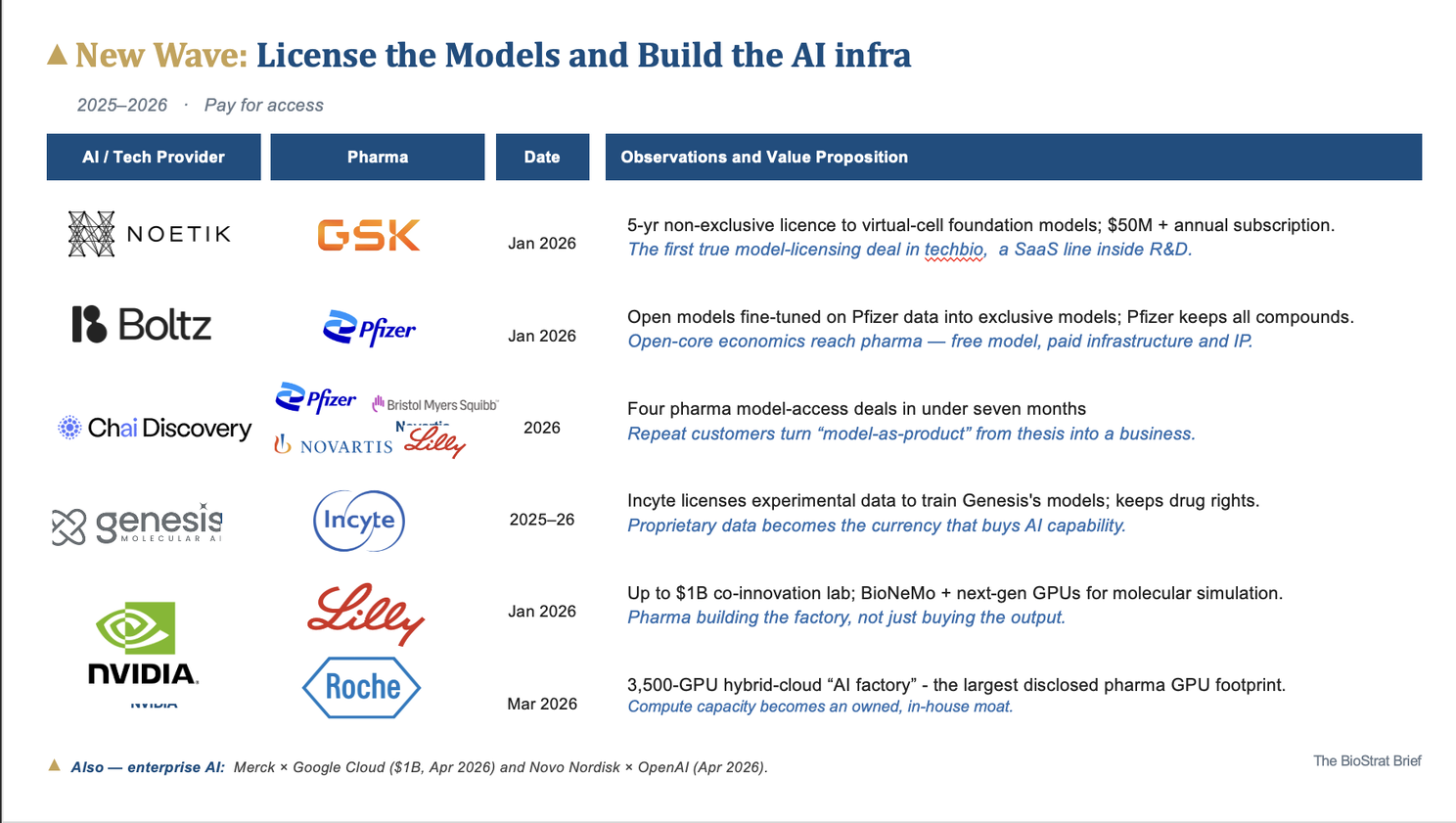
Before they could do this, they had to have the infrastructure to support it.
And beneath the licensing, pharma started buying the thing models run on. Lilly and NVIDIA committed up to $1B to a co-innovation lab. Roche stood up a 3,500-GPU "AI factory," the largest disclosed GPU footprint in the industry. Merck put $1B+ behind Google Cloud's Gemini; Novo Nordisk went enterprise-wide with OpenAI. This is pharma building the factory instead of buying the output.
AI Comes for Pharma (2026 →)
This infrastructure play taught the AI companies as well, And now the traffic runs both ways.
The most interesting deals of 2026 aren't pharma reaching out to AI. They're AI reaching into pharma and pharma reaching in to own the capability outright.
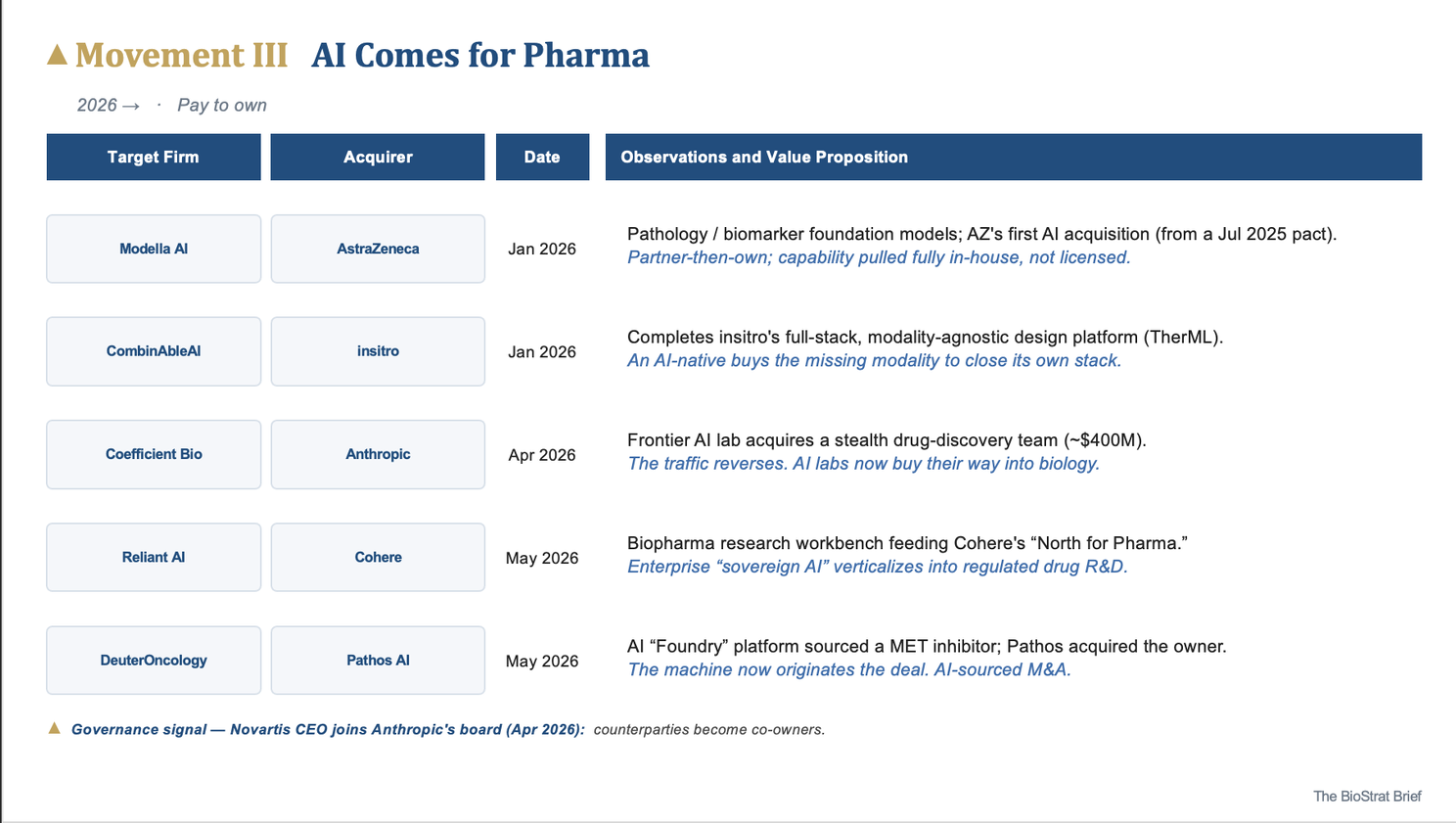
On the ownership side: AstraZeneca acquired Modella AI in January 2026, its first outright acquisition of an AI company, folding pathology foundation models directly into oncology R&D. insitro bought CombinAbleAI to complete a full-stack, modality-agnostic design platform. This is no longer "partner and wait." It's "buy it and run it."
On the incoming side, something genuinely new: the AI labs themselves crossed the border. Anthropic acquired Coefficient Bio for ~$400M — a frontier AI lab buying a drug-discovery team. Cohere bought Reliant AI to build a purpose-made biopharma research engine. ByteDance is running an internal drug-design unit. And Pathos let its AI source its own asset: its Foundry platform systematically flagged a MET inhibitor, and Pathos acquired the company that owned it. An acquisition originated by the machine.
If you want the single image that captures the shift, it isn't a deal at all. It's a board seat: in April 2026, Novartis's CEO joined Anthropic's board. Pharma and frontier AI are no longer counterparties across a contract. They're stitching themselves together at the level of governance.
The AI players are running a different playbook- Own. Through equity, M&A, acqui-hire, and AI-originated assets.
Three choices – which one to make?
The vector is running the course of: paying for outputs → paying for access → owning the capability.
These three eras are not just a chronology you watched happen. They are three options that are all live, right now. A company today can rent, build, or buy the same capability, and the sharp question is no longer "when did the industry move," but "which of these should we choose, for this capability, this quarter?" The field will only keep blurring: model subscriptions are becoming a standard R&D line item, and "pharma" and "AI company" are ceasing to be clean categories.
Rent: licence or subscribe When the capability is fast-moving and non-core, and you want the frontier without lock-in. The model will move faster than you can build it; GSK subscribing to Noetik's foundation models is the shape of it.
Build: own the compute, hire the team When the capability is core, durable, and compounds with your own proprietary data. Lilly's $1B NVIDIA lab and Roche's GPU factory are bets that owning the machine beats renting its output.
Buy: acquire or acqui-hire When the capability is strategic, you need control of the IP and the talent, and you can actually integrate them. AstraZeneca's move on Modella- a pilot in July, an acquisition by January
Building the flexible deal structure
Whatever rung you stand on, build the optionality into the structure itself: option-to-expand, option-to-acquire, data-for-model swaps, equity-plus-subscription hybrids. In a field moving this fast, pure biobucks aligns no one; the best deals now have a ladder built in.
If you sit on the techbio side - here's our take
Pick your model and commit - drug company, infrastructure provider, or deliberate hybrid, because the market rewards clarity and punishes ambiguity; Chai chose model-access-only and stacked four pharma customers in seven months. Turn the collaboration into a product: recurring revenue, like Noetik's subscription, is worth more than a bigger biobucks headline, and it compounds across customers. Guard the moat: data and exclusivity, deciding deliberately whether to multiply your market with non-exclusive terms or charge a premium for exclusivity. And if being acquired is the exit, build to be bought: the most valuable asset closes a buyer's stack gap cleanly, the way CombinAbleAI closed insitro's, because a sharp capability prices far better than a sprawling platform.
If this was useful, forward it to someone structuring their next AI deal.
About the author: Amandeep Singh, Ph.D. is the Founder of BioStrateon, a boutique corporate strategy and growth advisory firm for the life sciences sector. He leverages his deep domain expertise in drug discovery and dealmaking to help companies navigate capital markets, prioritize pipelines, and partner with big pharma.
First published in The BioStrat Brief on LinkedIn, 25 August 2026. Subscribe to The BioStrat Brief for a dealmaker's take on M&A, fundraising, strategy and markets in life sciences.